


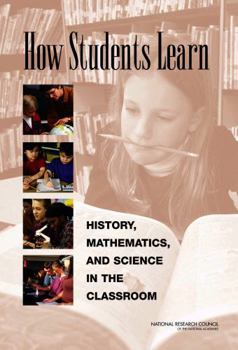
How Students Learn: History, Mathematics, and Science in the Classroom


How do you get a fourth-grader excited about history? How do you even begin to persuade high school students that mathematical functions are relevant to their everyday lives? In this volume, practical questions that confront every classroom teacher are addressed using the latest exciting research on cognition, teaching, and learning.
How Students Learn: History, Mathematics, and Science in the Classroom builds on the discoveries detailed in the bestselling How People Learn. Now, these findings are presented in a way that teachers can use immediately, to revitalize their work in the classroom for even greater effectiveness.
Organized for utility, the book explores how the principles of learning can be applied in teaching history, science, and math topics at three levels: elementary, middle, and high school. Leading educators explain in detail how they developed successful curricula and teaching approaches, presenting strategies that serve as models for curriculum development and classroom instruction. Their recounting of personal teaching experiences lends strength and warmth to this volume.
The book explores the importance of balancing students' knowledge of historical fact against their understanding of concepts, such as change and cause, and their skills in assessing historical accounts. It discusses how to build straightforward science experiments into true understanding of scientific principles. And it shows how to overcome the difficulties in teaching math to generate real insight and reasoning in math students. It also features illustrated suggestions for classroom activities.
How Students Learn offers a highly useful blend of principle and practice. It will be important not only to teachers, administrators, curriculum designers, and teacher educators, but also to parents and the larger community concerned about children's education.
How Students Learn: History, Mathematics, and Science in the Classroom builds on the discoveries detailed in the bestselling How People Learn. Now, these findings are presented in a way that teachers can use immediately, to revitalize their work in the classroom for even greater effectiveness.
Organized for utility, the book explores how the principles of learning can be applied in teaching history, science, and math topics at three levels: elementary, middle, and high school. Leading educators explain in detail how they developed successful curricula and teaching approaches, presenting strategies that serve as models for curriculum development and classroom instruction. Their recounting of personal teaching experiences lends strength and warmth to this volume.
The book explores the importance of balancing students' knowledge of historical fact against their understanding of concepts, such as change and cause, and their skills in assessing historical accounts. It discusses how to build straightforward science experiments into true understanding of scientific principles. And it shows how to overcome the difficulties in teaching math to generate real insight and reasoning in math students. It also features illustrated suggestions for classroom activities.
How Students Learn offers a highly useful blend of principle and practice. It will be important not only to teachers, administrators, curriculum designers, and teacher educators, but also to parents and the larger community concerned about children's education.
Format:Hardcover
Language:English
ISBN:0309074339
ISBN13:9780309074339
Release Date:December 2004
Publisher:National Academies Press
Length:632 Pages
Weight:3.25 lbs.
Dimensions:1.8" x 7.2" x 10.2"
Customer Reviews
3 ratings
good resource
Published by Thriftbooks.com User , 15 years ago
A good resource for all teachers, with explanations on how students learn each subject matter..
How Students Learn mathematics
Published by Thriftbooks.com User , 16 years ago
This is a great book that focuses on how students learn mathematics. The only reason I am not giving it 5 stars is it's difficult to read. The examples are great but the regular text uses words in such a way that you have to keep rereading. Unless you are the type of person that is comfortable with small and technical writing you will not enjoy reading this book. The book also provides a CD that focuses on Social Studies and Science.
Concise and Useful Approached to Teaching
Published by Thriftbooks.com User , 21 years ago
How Students Learn: History, Mathematics, and Science in the Classroom by M. Suzanne Donovan, John D. Bransford (National Academies Press) This book has its roots in the report of the Committee on Developments in the Science of Learning, How People Learn: Brain, Mind, Experience and School (National Research Council, 1999, National Academy Press). That report presented an illuminating review of research in a variety of fields that has advanced understanding of human learning. The report also made an important attempt to draw from that body of knowledge implications for teaching. A follow-on study by a second committee explored what research and development would need to be done, and how it would need to be communicated, to be especially useful to teachers, principals, superinten¬dents, and policy makers: How People Learn: Bridging Research and Prac¬tice (National Research Council, 1999). These two individual reports were combined to produce an expanded edition of How People Learn (National Research Council, 2000). We refer to this volume as HPL. In the present book, the goal is to take the HPL work to the next step: to provide examples of how the principles and findings on learning can be used to guide the teaching of a set of topics that commonly appear in the K-12 curriculum. As was the case in the original work (1999), the book focuses on three subject areas: history, mathematics, and science. Each area is treated at three levels: elementary, middle, and high school. Distinguished researchers who have extensive experience in teaching or in partnering with teachers were invited to contribute the chapters. The committee shaped the goals for the volume, and commented-sometimes extensively-on the draft chap¬ters as they were written and revised. The principles of HPL are embedded in each chapter, though there are differences from one chapter to the next in how explicitly they are discussed. Taking this next step to elaborate the HPL principles in context poses a potential problem that we wish to address at the outset. The meaning and relevance of the principles for classroom teaching can be made clearer with specific examples. At the same time, however, many of the specifics of a particular example could be replaced with others that are also consistent with the HPL principles. In looking at a single example, it can be difficult to distinguish what is necessary to effective teaching from what is effective but easily replaced. With this in mind, it is critical that the teaching and learning examples in each chapter be seen as illustrative, not as blueprints for the "right" way to teach. We can imagine, by analogy, that engineering students will better grasp the relationship between the laws of physics and the construction of effec¬tive supports for a bridge if they see some examples of well-designed bridges, accompanied by explanations for the choices of the critical design features. The challenging engineering task of crossing the entrance of the S
Copyright © 2026 Thriftbooks.com Terms of Use
| Privacy Policy | Do Not
Sell/Share My Personal Information | Cookie Policy | Cookie Preferences | Accessibility Statement
ThriftBooks® and the ThriftBooks® logo are registered trademarks of Thrift Books Global, LLC
ThriftBooks® and the ThriftBooks® logo are registered trademarks of Thrift Books Global, LLC
