


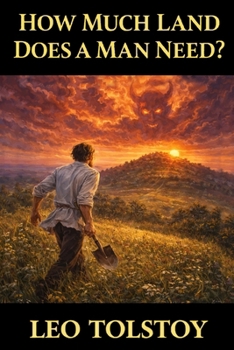
How Much Land Does a Man Need?

Select Format
Select Condition 
Book Overview
How Much Land Does a Man Need? by Leo Tolstoy is one of the most enduring moral short stories in world literature. First published in 1886, this classic tale examines greed, ambition, property, and the illusion of wealth through a simple but devastating narrative. Set in rural Russia, the story follows a peasant whose desire for land grows without limit, revealing the destructive consequences of material obsession.
Tolstoy uses plain language and folklike structure to deliver a sharp ethical critique of private ownership, social inequality, and the human craving for more than is necessary. As the protagonist seeks security through land accumulation, he becomes trapped by his own desires, illustrating Tolstoy's belief that moral failure arises not from poverty but from excess. The story addresses themes of mortality, temptation, self deception, and the contrast between spiritual sufficiency and material accumulation.
Widely taught in schools and studied in philosophy, ethics, and literature courses, How Much Land Does a Man Need? remains relevant for readers interested in moral philosophy, social justice, agrarian life, and critiques of capitalism. It stands alongside Tolstoy's later ethical writings in its rejection of materialism and its insistence on simplicity, restraint, and inner freedom. This edition presents a timeless literary parable whose central question continues to challenge modern assumptions about success, ownership, and happiness.
Available in Kindle, Paperback, and Hardback formats.
Customer Reviews
ThriftBooks® and the ThriftBooks® logo are registered trademarks of Thrift Books Global, LLC
