


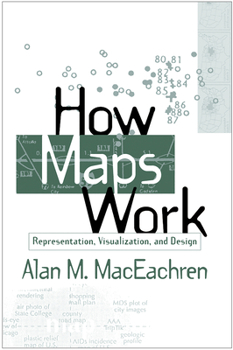
How Maps Work: Representation, Visualization, and Design


Select Format
Select Condition 
Book Overview
Now available in paperback for the first time, this classic work presents a cognitive-semiotic framework for understanding how maps work as powerful, abstract, and synthetic spatial representations. Explored are the ways in which the many representational choices inherent in mapping interact with information processing and knowledge construction, and how the resulting insights can be used to make informed symbolization and design decisions. A new preface to the paperback edition situates the book within the context of contemporary technologies. As the nature of maps continues to evolve, Alan MacEachren emphasizes the ongoing need to think systematically about the ways people interact with and use spatial information.
Format:Paperback
Language:English
ISBN:157230040X
ISBN13:9781572300408
Release Date:June 2004
Publisher:Guilford Publications
Length:513 Pages
Weight:1.88 lbs.
Dimensions:1.3" x 6.4" x 9.0"
Customer Reviews
3 ratings
Tons of information, but very poorly presented
Published by Thriftbooks.com User , 18 years ago
A book of such depth and with so much information packed into such little space deserves no less than five stars-unless the presentation is so poor that reading becomes a chore! Make no mistake: this is a superb textbook. You get exactly what the title says: a comprehensive guide to principles of psychology, perception, semiotics, design, visualization-you name it. If there is an issue in the world that concerns map design, chances are excellent that you will find it in this book. The author is an expert in the field and it shows. If you think you can get beyond the usability problems, by all means buy this book and it will keep you thinking for a very long time. Yet, for a book that has 'design' in its sub-title, clearly the design of the book itself was done with little consideration for the reader. The type is small, needs a better font and is cluttered with references, (text in parentheses) and "quoted phrases". It doesn't help that the text is poorly justified resulting in a ridiculous amount of hyphenation. You don't have to really read the whole book to see what I mean-just look at the table of contents. Does that look like a book designed by someone who cares about psychology, design, perception and visual presentation? There isn't even any space to take notes. If you are used to reading scientific papers, you won't have much trouble because their presentation is usually far worse. Otherwise, be prepared for a rough ride.
Solid book, full of insight
Published by Thriftbooks.com User , 24 years ago
This is an exceptionally thorough guide to map representation both in design and function. If you love maps or use them a lot in your work, this is a truly great book to own. It covers both functional and lexical mapping techniques from both visual perception/cognition and semiotic design perspectives. Pose any question about mapping and this book can probably help you find the answer to it. This book will especially please information designers/architects.
so you think you know cognitive-semiotic approaches to maps?
Published by Thriftbooks.com User , 26 years ago
My copy of this book is now chock full of scribbles in the margin - not doodles, mind you, but ideas and questions for research in cartographic design. There are a few doodles, too, but they're doodles of maps. The book asks as many questions as it answers, and as such makes a great text for researchers, students, and folks who want to look at what the future of cartography could be...
Copyright © 2026 Thriftbooks.com
Terms of Use | Privacy Policy | Do Not Sell/Share My Personal Information | Cookie Policy | Cookie Preferences | Accessibility Statement
ThriftBooks ® and the ThriftBooks ® logo are registered trademarks of Thrift Books Global, LLC
ThriftBooks ® and the ThriftBooks ® logo are registered trademarks of Thrift Books Global, LLC
