


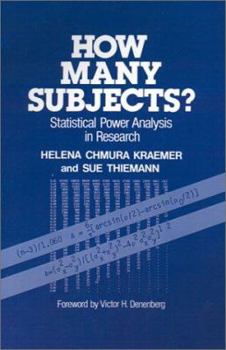
How Many Subjects?: Statistical Power Analysis in Research

Select Format
Select Condition 
Book Overview
′This book fills a large gap in the applied statistics literature and, at the same time, provides empirical researchers with the means to quickly determine a valuable piece of information, namely: what sample size is needed for a particular study. If this book only presented the reader with a straightforward set of procedures for determining N for any particular research design, it would have fulfilled its mission successfully. But the book does more. . . . How Many Subjects? has much to offer the careful and interested reader." --from the Foreword by Victor H. Denenberg
"How Many Subjects? provides a ′cookbook′ enabling researchers to plan an analysis that gives their alternative or research hypotheses a reasonable chance of being supported . . . useful to those with limited statistical background who simply need a guide to evaluating the power of a test contained in others′ research, or to selecting the proper sample size to achieve a given level of power in their own research." --Contemporary Sociology
"Until now no broad framework has existed to treat power in a unified fashion across hypothesis testing techniques. . . . An excellent contribution to the literature. . . . A valuable reference book. . . . A nice addition to the statistical literature. How Many Subjects? should be at the disposal of teachers and students of statistics." --Applied Psychological Measurement
"This is a simple introduction for non-statisticians to power analysis and sample size determination. Helena Chmura Kraemer and Sue Thiemann have produced an easily readable book that clearly illustrates why sample sizes need to be sufficiently large, so that the experiment has good power properties and hence low type II error rates. . . . This book is an excellent introduction to the problem and whets the appetite to find out more." --The Statistician
"A success. . . . For graduate students, there is no question about the book′s value. I think that all graduate students should be advised to read this book before starting significant projects such as a dissertation." --Journal of Marketing Research
The authors introduce a simple technique of statistical power analysis that allows researchers to compute approximate sample sizes and power for a wide variety of research designs. Because the same technique is used with only slight modifications for different statistical tests, researchers can easily compare the sample sizes required by different designs and tests to make cost-effective decisions in planning a study. These comparisons, emphasized throughout the book, demonstrate some important principles of design, measurement, and analysis that are rarely discussed in courses or textbooks. This book therefore serves not merely as a "how-to" reference for sample size calculations but also as a guide to some general principles of cost-effective research.
"How Many Subjects? provides a ′cookbook′ enabling researchers to plan an analysis that gives their alternative or research hypotheses a reasonable chance of being supported . . . useful to those with limited statistical background who simply need a guide to evaluating the power of a test contained in others′ research, or to selecting the proper sample size to achieve a given level of power in their own research." --Contemporary Sociology
"Until now no broad framework has existed to treat power in a unified fashion across hypothesis testing techniques. . . . An excellent contribution to the literature. . . . A valuable reference book. . . . A nice addition to the statistical literature. How Many Subjects? should be at the disposal of teachers and students of statistics." --Applied Psychological Measurement
"This is a simple introduction for non-statisticians to power analysis and sample size determination. Helena Chmura Kraemer and Sue Thiemann have produced an easily readable book that clearly illustrates why sample sizes need to be sufficiently large, so that the experiment has good power properties and hence low type II error rates. . . . This book is an excellent introduction to the problem and whets the appetite to find out more." --The Statistician
"A success. . . . For graduate students, there is no question about the book′s value. I think that all graduate students should be advised to read this book before starting significant projects such as a dissertation." --Journal of Marketing Research
The authors introduce a simple technique of statistical power analysis that allows researchers to compute approximate sample sizes and power for a wide variety of research designs. Because the same technique is used with only slight modifications for different statistical tests, researchers can easily compare the sample sizes required by different designs and tests to make cost-effective decisions in planning a study. These comparisons, emphasized throughout the book, demonstrate some important principles of design, measurement, and analysis that are rarely discussed in courses or textbooks. This book therefore serves not merely as a "how-to" reference for sample size calculations but also as a guide to some general principles of cost-effective research.
Format:Hardcover
Language:English
ISBN:0803929498
ISBN13:9780803929494
Release Date:September 1987
Publisher:SAGE Publications, Inc
Length:120 Pages
Weight:0.75 lbs.
Dimensions:9.0" x 0.8" x 5.8"
Customer Reviews
2 ratings
significance and power
Published by Thriftbooks.com User , 17 years ago
Whatever your statistical background, the approach of this book to the question of statistical power is highly illuminating. For instance, I am a poor statistician, primarily an engineer with a mathematical bent. I happen to fall into experimental and, thus, statistical contexts frequently. Nevertheless, this book elucidated the issues surrounding the somewhat ritualistic "receiver operating characteristics" tradeoffs routine of detectability versus false alarm rate more than any text in my experience. It showed how costs of failures factored into the decision threshold, rather than making some routine mimickry of a classroom derivation. So even if statistical power isn't a routine place to visit, this book is worthwhile. I'd say, however, that matters of statistical power ought to be considered more than they are, even if they aren't a natural fit for Bayesian formulations, which seem currently to be in vogue.
simple well-written book about sample size determination
Published by Thriftbooks.com User , 18 years ago
Helen Kraemer is a Stanford Professor with a subspecialty in statistics. She wrote this delightful book with the simple title "How many subjects." Along with Jacob Cohen's book this was one of the first statistical textbooks devoted to the determination of power and sample size in hypothesis testing situations. It is a great reference book on the topic. With the appearance of statistical software to handle the problems addressed in these books and more, the book now serve the purpose of providing a deeper understanding of the issues and an aid to help the user understand what the parameters (e.g. effect size, subject to subject variance) mean.
Copyright © 2026 Thriftbooks.com
Terms of Use | Privacy Policy | Do Not Sell/Share My Personal Information | Cookie Policy | Cookie Preferences | Accessibility Statement
ThriftBooks ® and the ThriftBooks ® logo are registered trademarks of Thrift Books Global, LLC
ThriftBooks ® and the ThriftBooks ® logo are registered trademarks of Thrift Books Global, LLC
