


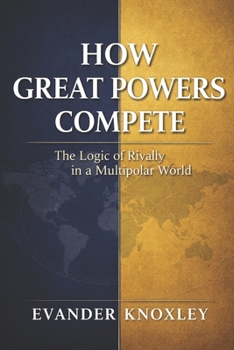
How Great Powers Compete: The Logic of Rivalry in a Multipolar World
No Customer Reviews

The unipolar moment is over. Three major powers are competing for influence, security,
and strategic advantage in a world where no single state
can impose its will. Understanding the logic of that rivalry is no longer
optional. The United States, China, and Russia are not competing
because their leaders are reckless or their populations
are hostile. They are competing because the structure of
the international system creates incentives for rivalry
that persist regardless of who is in power, what
agreements are signed, or how much trade flows between them. This is what most coverage of global politics gets wrong.
The headlines focus on personalities, incidents, and
rhetoric. The structural forces driving great power
behavior operate beneath all of that and they are
knowable. How Great Powers Compete provides the analytical
framework the current moment demands: a rigorous,
neutral examination of why great powers behave the way
they do across military, economic, technological,
and institutional domains and what mechanisms
exist to manage rivalry without catastrophe. In this book, you will understand:
Why the security dilemma drives arms races and
alliance formation even when no state seeks conflict
and why this dynamic is intensifying, not stabilizing
How economic interdependence coexists with and
actively enables intense strategic rivalry between
the same states that trade with each other
Why the United States, China, and Russia each
behave as they do explained through structural
logic rather than ideology or leadership personality
How the Indo-Pacific and European theaters differ
in competitive dynamics, escalation risk, and the
role of regional powers
What pathways lead from managed competition to
catastrophic miscalculation and what has historically
prevented them
How deterrence theory, balance of threat, and
alliance dynamics translate from academic frameworks
into the decisions shaping today's headlines
Written for serious readers who want clarity without
simplification. This book translates the core frameworks
of international relations scholarship into accessible
prose that preserves analytical rigor without the
jargon, without the ideology, and without the false
certainty of prediction. This book is for: policy professionals, engaged
citizens trying to make sense of global headlines,
students seeking frameworks that will outlast any
single crisis, and anyone who suspects that the world
is more structurally dangerous than the news cycle suggests. How Great Powers Compete is Book 2 of
The Anatomy of Power Series by Evander Knoxley. Read the Primer Beyond Realism and Liberalism
for the theoretical foundations that underpin this
analysis. Continue with Book 3, Alliance Politics
in Practice, to understand how states build and
manage the security partnerships that define great
power competition.
and strategic advantage in a world where no single state
can impose its will. Understanding the logic of that rivalry is no longer
optional. The United States, China, and Russia are not competing
because their leaders are reckless or their populations
are hostile. They are competing because the structure of
the international system creates incentives for rivalry
that persist regardless of who is in power, what
agreements are signed, or how much trade flows between them. This is what most coverage of global politics gets wrong.
The headlines focus on personalities, incidents, and
rhetoric. The structural forces driving great power
behavior operate beneath all of that and they are
knowable. How Great Powers Compete provides the analytical
framework the current moment demands: a rigorous,
neutral examination of why great powers behave the way
they do across military, economic, technological,
and institutional domains and what mechanisms
exist to manage rivalry without catastrophe. In this book, you will understand:
Why the security dilemma drives arms races and
alliance formation even when no state seeks conflict
and why this dynamic is intensifying, not stabilizing
How economic interdependence coexists with and
actively enables intense strategic rivalry between
the same states that trade with each other
Why the United States, China, and Russia each
behave as they do explained through structural
logic rather than ideology or leadership personality
How the Indo-Pacific and European theaters differ
in competitive dynamics, escalation risk, and the
role of regional powers
What pathways lead from managed competition to
catastrophic miscalculation and what has historically
prevented them
How deterrence theory, balance of threat, and
alliance dynamics translate from academic frameworks
into the decisions shaping today's headlines
Written for serious readers who want clarity without
simplification. This book translates the core frameworks
of international relations scholarship into accessible
prose that preserves analytical rigor without the
jargon, without the ideology, and without the false
certainty of prediction. This book is for: policy professionals, engaged
citizens trying to make sense of global headlines,
students seeking frameworks that will outlast any
single crisis, and anyone who suspects that the world
is more structurally dangerous than the news cycle suggests. How Great Powers Compete is Book 2 of
The Anatomy of Power Series by Evander Knoxley. Read the Primer Beyond Realism and Liberalism
for the theoretical foundations that underpin this
analysis. Continue with Book 3, Alliance Politics
in Practice, to understand how states build and
manage the security partnerships that define great
power competition.
Format:Paperback
Language:English
ISBN:B0GJCND3MX
ISBN13:9798245068824
Release Date:January 2026
Publisher:Independently Published
Length:176 Pages
Weight:0.49 lbs.
Dimensions:0.4" x 6.0" x 9.0"
Customer Reviews
0 rating
Copyright © 2026 Thriftbooks.com
Terms of Use | Privacy Policy | Do Not Sell/Share My Personal Information | Cookie Policy | Cookie Preferences | Accessibility Statement
ThriftBooks ® and the ThriftBooks ® logo are registered trademarks of Thrift Books Global, LLC
ThriftBooks ® and the ThriftBooks ® logo are registered trademarks of Thrift Books Global, LLC
