


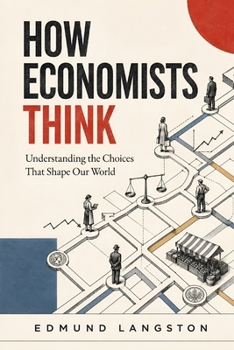
How Economists Think: Understanding the Choices That Shape Our World

Why do people respond to incentives in unexpected ways? Why do well-intended policies sometimes fail? Why do markets coordinate millions of decisions so effectively in some situations, yet break down in others?
How Economists Think is an accessible guide to the ideas, habits, and mental models economists use to understand the world. Rather than focusing on complicated equations or technical theory, this book explains the reasoning behind economics: how economists frame problems, compare alternatives, evaluate evidence, trace incentives, and identify the trade-offs hidden inside everyday choices.
Across twenty clear and engaging chapters, you will learn how economists think about scarcity, opportunity cost, marginal decisions, markets, government policy, human behavior, institutions, labor, money, banking, economic growth, trade, development, inequality, and the environment. You will also discover why economists rely on models, how they separate correlation from causation, and why the right question is often more valuable than a quick answer.
Written for curious readers with no prior background in economics, How Economists Think shows that economics is not merely the study of money. It is the study of choices, consequences, and the forces that shape the world around us. If you want to understand not only what happens in the economy, but why it happens, this book will give you the tools to see more clearly.
You will learn how to:
Understand the incentives behind behavior
Recognize hidden costs and unintended consequences
Evaluate claims, charts, and economic arguments more critically
Distinguish efficiency from fairness
Think more clearly about markets, governments, and institutions
Make better decisions under uncertainty
Customer Reviews
ThriftBooks ® and the ThriftBooks ® logo are registered trademarks of Thrift Books Global, LLC
