


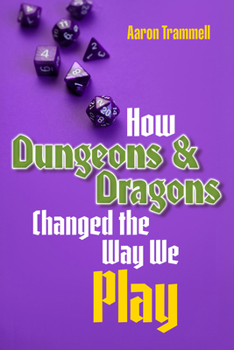
How Dungeons & Dragons Changed the Way We Play
No Customer Reviews

First released in 1974, Dungeons & Dragons revolutionized game design and interactive media by allowing players to create and perform their own fictional characters in a fantasy world as expansive as their imaginations would allow. That freedom, and the rules that governed it, weren't a creative coincidence. In How Dungeons & Dragons Changed the Way We Play, Aaron Trammell excavates the game as an artifact of a burgeoning counterculture obsessed with individualism as well as quantification. Mapping the world onto a grid, building characters whose every trait is assigned a point value, and advancing the game's narrative through dice throws--countless core mechanics are tied to numbers. Putting the game design of D&D into dialogue with the social and political tensions of the 1970s and 80s, Trammell illuminates how the integrated quantification in the game design led to reductionism, reinforced oppressive gender and racial norms, and accustomed generations of players to the bigoted, xenophobic mores of the Cold War era. He delivers a history of both how games can shape players and how players, united by their own shared values, can shape games in turn.
Format:Hardcover
Language:English
ISBN:1478034130
ISBN13:9781478034131
Release Date:September 2026
Publisher:Duke University Press
Length:182 Pages
Customer Reviews
0 rating
Copyright © 2026 Thriftbooks.com
Terms of Use | Privacy Policy | Do Not Sell/Share My Personal Information | Cookie Policy | Cookie Preferences | Accessibility Statement
ThriftBooks ® and the ThriftBooks ® logo are registered trademarks of Thrift Books Global, LLC
ThriftBooks ® and the ThriftBooks ® logo are registered trademarks of Thrift Books Global, LLC
