


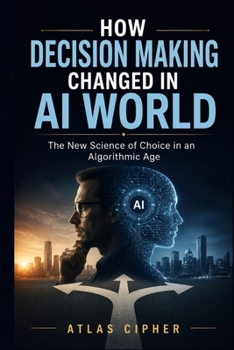
How Decision Making Changed in AI World: The New Science of Choice in an Algorithmic Age

Every day, algorithms help decide who gets a loan, who gets interviewed for a job, which patients get flagged for further testing, and which defendants get released on bail. How Decision Making Changed in AI World traces what happens to human judgment when a machine enters the decision process.
The book opens with the science of human choice before algorithms arrived: the rational actor model, the behavioral research of Daniel Kahneman and Amos Tversky, and Herbert Simon's bounded rationality. It then follows algorithmic decision making into credit scoring, hiring, medicine, criminal justice, and finance, explaining in plain language how these systems actually learn, why they find patterns instead of reasons, and what decades of research comparing statistical and human judgment reveal.
Drawing on documented cases, including the COMPAS controversy, an abandoned Amazon hiring tool, and government failures in the Netherlands, the United Kingdom, and Australia, the book examines where human oversight of these systems succeeds and where it quietly fails. It closes with a practical framework: specific questions for evaluating any algorithmic recommendation, principles for individuals and organizations, and an honest account of what these systems still cannot do.
Written for professionals in medicine, hiring, and finance, for readers navigating their own algorithmic decisions, and for anyone curious about how choice itself has changed, this book presents a new science of choice grounded in documented history rather than speculation.
Customer Reviews
ThriftBooks ® and the ThriftBooks ® logo are registered trademarks of Thrift Books Global, LLC
