


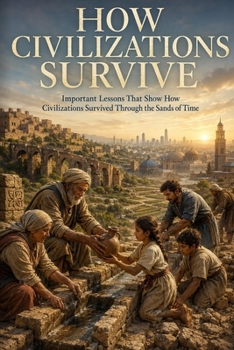
How Civilizations Survive: Important Lessons That Show How Civilizations Survived Through the Sands of Time

Why do some civilizations endure for centuries while others weaken, fracture, and disappear?
How Civilizations Survive explores the forces that allow societies to withstand war, political upheaval, environmental change, economic decline, disease, internal division, and the pressures of time. Drawing lessons from civilizations across the ancient, medieval, and modern worlds, this book examines the practical foundations of long-term survival-from trustworthy institutions and responsible leadership to adaptable economies, shared knowledge, social unity, and the ability to learn from crisis.
Through compelling historical examples, readers will discover how civilizations protected essential resources, managed succession, absorbed new people and ideas, maintained public infrastructure, responded to natural disasters, preserved cultural memory, and renewed themselves without abandoning their identity. The book also reveals the recurring dangers that place societies at risk, including corruption, extreme inequality, weakened institutions, uncontrolled debt, military interference, environmental neglect, and resistance to necessary reform.
Rather than treating history as a simple record of rulers, battles, and fallen empires, How Civilizations Survive searches for the deeper patterns behind endurance. It shows that survival rarely depends on strength alone. Lasting civilizations are those capable of adapting, correcting their mistakes, preserving what works, and rebuilding when circumstances change.
Accessible, thoughtful, and rich with historical insight, this book is ideal for readers interested in world history, political development, social resilience, leadership, and the lessons the past can offer the present.
History remembers how civilizations fell. This book asks the more important question: how did they survive?
Customer Reviews
ThriftBooks ® and the ThriftBooks ® logo are registered trademarks of Thrift Books Global, LLC
