


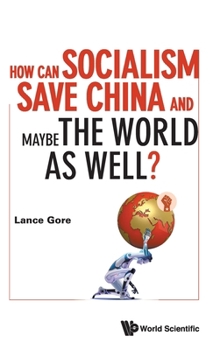
How Can Socialism Save China and Maybe the World as Well?

This book explores one of the most urgent questions of our time: how can socialism help humanity navigate the challenges of the AI age? The rapid proliferation of artificial intelligence raises serious concerns about the future of humanity-concerns for which we are woefully unprepared, as many leading thinkers have warned. AI is intensifying deep-rooted problems within capitalism, such as job displacement and widening wealth inequality, while also paving the way for a necessary transition beyond capitalism.
Post-capitalism is framed here not merely as an economic shift, but as a civilizational project-one that moves from a world defined by scarcity to one of abundance. This transformation requires questioning many of the basic assumptions that have shaped capitalist and pre-capitalist societies. Our biggest obstacle is our inability to break free from long-held, taken-for-granted ways of thinking. Using China as the central case study, the book outlines key elements of a post-capitalist civilization: from motivation and wealth distribution, to innovation, entrepreneurship, markets, and modes of production.
Focusing on solving the most important problems confronting humanity, this book offers out-of-the-box ideas rooted in the context of China's ongoing experiment with "socialism with Chinese characteristics for a new era." With a shorter history of capitalism and less attachment to Western liberalism, China may be uniquely positioned to lead the transition-if it can think clearly and boldly on a civilizational scale. This thought-provoking work invites readers to rethink the future, not just for China, but for the world.
Customer Reviews
ThriftBooks ® and the ThriftBooks ® logo are registered trademarks of Thrift Books Global, LLC
