


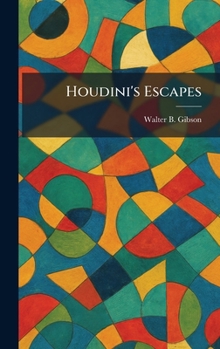
Houdini's Escapes

"Houdini's Escapes" serves as a definitive exploration into the methods and legendary performances of Harry Houdini, the world's most renowned escape artist. Compiled by Walter B. Gibson from Houdini's own private notebooks and records, this work unveils the technical ingenuity behind the illusions that captivated audiences across the globe. The book details a wide array of daring feats, including escapes from handcuffs, ropes, straitjackets, and elaborate water-filled containers.
Readers are provided with a rare glimpse into the meticulous preparation and physical discipline required to execute such life-threatening stunts. Beyond the technical explanations, the text captures the spirit of an era where magic and mystery reigned supreme in the world of entertainment. Walter B. Gibson, a celebrated writer and confidant of magicians, ensures that the master's legacy is preserved through clear descriptions and insights into the psychology of performance. Whether examining the mechanics of locks or the art of misdirection, "Houdini's Escapes" remains an essential resource for those interested in the history of stage magic, the evolution of escapology, and the enduring mythos of the man who could not be held.
This work has been selected by scholars as being culturally important, and is part of the knowledge base of civilization as we know it. This work was reproduced from the original artifact, and remains as true to the original work as possible. Therefore, you may see the original copyright references, library stamps (as most of these works have been housed in our most important libraries around the world), and other notations in the work.
This work is in the public domain in the United States of America, and possibly other nations. Within the United States, you may freely copy and distribute this work, as no entity (individual or corporate) has a copyright on the body of the work.
As a reproduction of a historical artifact, this work may contain missing or blurred pages, poor pictures, errant marks, etc. Scholars believe, and we concur, that this work is important enough to be preserved, reproduced, and made generally available to the public. We appreciate your support of the preservation process, and thank you for being an important part of keeping this knowledge alive and relevant.
Customer Reviews
ThriftBooks ® and the ThriftBooks ® logo are registered trademarks of Thrift Books Global, LLC
