


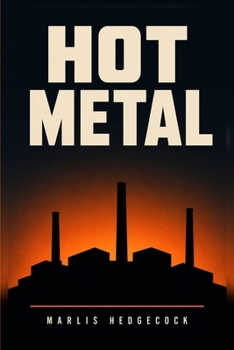
Hot Metal

In thirty-one months inside that mill, I never once heard a human voice.
January 1943. Billie Zaruba is nineteen, and she quits a filing job at eleven dollars a week for sixty-two cents an hour at Kirkpatrick Steel, in a valley town where the mill is four thousand jobs and the whole sky and the reason anybody is there at all.
Her grandmother says one sentence about it, in Slovak, and never mentions it again: "Then you will know what your grandfather knew."
He went into the open hearth on a Tuesday in 1921 and did not come out.
WHAT THIS IS
A home-front novel told from inside the noise. Billie writes it down herself in 1978, at fifty-four, at a kitchen table, thirty-two years after a slip four and a half inches by three came in her pay envelope and ended it. She is not a reliable narrator and she says so. She revises herself. More than once she admits she told a story a particular way for twenty years and then found out it was not true.
- A charging crane sixty feet above twelve furnaces, at a hundred and thirty-one degrees, where the only language is forty hand signals that were never written down
- Eleven women in one department, named - all eleven, because nobody else ever has
- One washhouse for eleven hundred men, and the woman who got a second one in nine days by refusing to ask for it
- A grandmother awake in a lit kitchen at every hour of every shift for three years
- A mother who walked toward the telegram bicycle
- Four seconds in February 1945 that a foreman wrote down wrong on purpose
- And the phrase that was on every application form in the country and that nobody explained: for the duration
WHAT IT REFUSES TO DO
There is no villain. The seniority that ended it was lawful, was foreseen, and was right - her own brother came home from the Pacific at a hundred and thirty-nine pounds and got his job back, and she would not undo it for anything. The union both failed them and fought for them, in the same eighteen months. And she was, for three years, happier than she has ever been since, about a war she wanted to end.
She has never got over the job. She has never got over what came after it, which was worse: coming home and having nothing to say.
FOR READERS OF
Quiet, unsentimental historical fiction about working women and industrial towns: The Four Winds, We Were the Lucky Ones, anything by Kent Haruf. Anyone whose grandmother did something in the war and would never talk about it.
Customer Reviews
ThriftBooks ® and the ThriftBooks ® logo are registered trademarks of Thrift Books Global, LLC
