


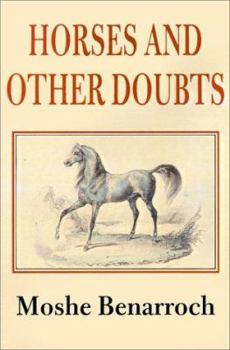
Horses and Other Doubts

Moshe Benarroch was born in 1959 in Tetuan/Morocco, between Tangier and Gibraltar. He grew up in a mixture of cultures and languages, Spanish being his mother tongue, attending a French school,... This description may be from another edition of this product.
Format:Paperback
Language:English
ISBN:0595137334
ISBN13:9780595137336
Release Date:September 2000
Publisher:iUniverse
Length:124 Pages
Weight:0.46 lbs.
Dimensions:0.3" x 6.0" x 9.0"
Related Subjects
PoetryCustomer Reviews
5 ratings
A Compelling Read From Benarroch Once More
Published by Thriftbooks.com User , 23 years ago
Moshe Benarroch once again comprises a collection of stirring poetry that will haunt long after "Horses and Other Doubts" is put down. In the tradition of his previous book, "The Immigrant's Lament", international author Benarroch takes his readers on a paradoxical view of the world, his world, in a unique mix of powerful emotion that is tightly constrained, a multi-nationional perspective, yet one that holds the reader close to Benarroch's bakcyard, through eyes that have seen it all, but still seek answers."We Count Our Dead" is a perfect example of this, for Benarroch speaks of a theme that wants to rip with rage, pathos, and grief, but with skill he keeps these components effectively simmering beneath the poem's surface to pack the most punch with his carefully chosen words. "Horses and Other Doubts" is a book that compels to be read again and again, with each concept mulled over, each nuance absorbed, and every word savoured, for while the images at times are disturbing ones, the art in which Benarroch handles the written word is all pleasure.
Horses and more horses
Published by Thriftbooks.com User , 24 years ago
"Horses and other doubts" is another great book by multilingual Israeli poet Moshe Benarroch. But it seems to me that some of the poems, as it happen with great poems, have changed their meaning since sept. 11. Here are the first two poems from the book:Horses~~~~~~Andthey will come runninggalloping gallopinggray black blue horsesforgotten horseshorses from all the centurieswill cometo crush everything they seewomen men and childrenand donkeys and foxes and dogs and catsCome they will Comehorses and more horsesand nobody will be able to stop themnot atomic bombsnor gases nor chemicals nor virusesthey will be the strongest horses that ever existedhorses that recall allthe injustices made and to be madeand the man will askWhy in my time Why in my houseWhy my family and my childrenand nobody will be able to answerthe blue horses, the celestial horsesthose will be the worstdestroying 200 story buildings destroying tanks and planesblowing them apartand the president will calmand the specialists will analyzeand the televisions will speakbut nothing will helpmore and more horses will comeout of nowherehorses appearing suddenlyin front of people walking on the streetsand you, in bed, you'll look at medespaired, waiting for rescueI will look at you and suddenly I will become a red horse. We Count Our Dead~~~~~~~~~~~~~~~~When we go to sleep we count our deadWhen we wake upwe count our deadWhen we end the centurywe count our deadWhen we killwe count our deadWhen we livewe count our deadWhen we eatwe count our deadWhen we praywe count our deadWhen we celebrate lifewe count our deadWhen we write a poemwe count our dead.I wouldn't call this prophecy but maybe it's not far from it. It shows how far words can go, and how the infractsructure of language can carry the future in it. The book goes on with poems of decaying cities (old cities like Paris) life and immigration, a poem about a Hamass terrorist and a terrorist attack in Tel Aviv, when the poet was a free blocks away. But Benarroch's poetry is not pessimistic, it is cynical, maybe we can call it cynical optimism. There is always a grain of hope, in the darkest moments, and a grain of despair in the brightest ones.A poet to follow, read and reread. I think that the poem "Horses" (first printed in Galaxy mag. in 1999) , is bound to become a classic as "Ithaca" or "Howl", any day soon. It has been traveling the world through thousands of emails...
From a Writer Who Deserves a Large Worldwide Audience
Published by Thriftbooks.com User , 25 years ago
Moshe Bennaroch has a unique voice and writes like no one else. He brings to us his truth of many diverse geographies and truly writes as a citizen of the world, and as one who has heart and feeling for populations that transcend borders and ideologies. The title of the book is lovely and quirky -- and like a Zen Koan it intrigues and rather short circuits the reader's left brain, leading him or her into a world where poetry rules, where indeed poetry succeeds in making sense of life, which often gives us a reality of senselessness and chaos. Moshe Bennaroch brings us a poetry of uncanny sensibilities, of insight, of music of the desert, the oasis and the clouds that touch everywhere -- and ultimately he gives us a poetry of peace. May the world have ears.Maria Jacketti Jacketti_M@spcvxa.spc.edu
One of a kind
Published by Thriftbooks.com User , 25 years ago
Moshe Benarroch is one of the leading poets in Israel, and has been called by Natan Zach "The best young poet of his generation". A poet who writes in three languages is already a rare event, he writes fluently in both Hebrew, Spanish and English. His poems appear regulary ... in magazines in Israel, Spain and the U.S.What most strikes about his poetry is a sense of purpose with a clarity only found in a poet like Charles Bukowski, that he so admires. But behind these simple words a complex texture is build line by line, and word by word, making his poems real adventures and discoveries.Try this book before the others, Benarroch will probably become one of the leading poets in the world in the next ten years. ...here isthe last short poem "Freedom" which closes the book:Freedom is what starts a poem/ but by the end you're always back in jail.
Which Ones to Write, Which Ones to Leave
Published by Thriftbooks.com User , 25 years ago
Moshe Benarroch's title for his first book of poems in English, Horses and Other Doubts, seems ironic, because this is a poet with an established international audience, charging headlong into a wide range of subjects, love, war, discrimination, Zionism, and poetry, a poet who writes in "The Poem" "they {poems} all want to be written/ screaming at me/ convincing me/ asking and begging/ but I have to make the choice/ which ones I write/ which ones to leave."and maybe "which ones to leave" is the poet's dilemma, the other doubts in his title. Benarroch's a prolific writer with five books to his credit; in this one he leads with "Horses," the powerful steam-roller he's best known for. He writes: "horses from all the centuries/ will come/ to crush everything they see..." and asks: "Why in my time/ Why in my house/ Why my family and my children/ and nobody will be able to answer..."There's a memorable line in almost every poem: (he's mastered the poet's toughest problem - all poets pray for just one good line in a poem; more than one is considered a miracle) In "The Evening Before," he inquires about death - asking: "what is the color of this angel, the shape of the shoes/ does he run, or is death just the moment when the/ angel of life/ tires of us, and goes for another soul..."In "Zionism" he is resolute: "... you made me/ a master forgetter/ Till I forgot you/ and remembered all this."Benarroch's a realist too, understanding the artist's angst, especially the poet's; I suspect he, like many other poets, would write twenty-four hours a day, given the chance, yet given the reality all poet's face, he must work at something else to keep the wolf away from the door, so he pines: "There is no job that fits a poet."Benarroch's accesible, and worth reading; most of his poems chew on the bones of human experience, much of which is raw. Finally, he's refreshingly demanding, much like a prof in a Lit class. In "The Reader" he addresses the "good reader:" "...his interaction/ creates the/ echo/ that brings/ to the poem/ someone who's/ never read poetry./ He's the best."
Copyright © 2026 Thriftbooks.com
Terms of Use | Privacy Policy | Do Not Sell/Share My Personal Information | Cookie Policy | Cookie Preferences | Accessibility Statement
ThriftBooks ® and the ThriftBooks ® logo are registered trademarks of Thrift Books Global, LLC
ThriftBooks ® and the ThriftBooks ® logo are registered trademarks of Thrift Books Global, LLC
