


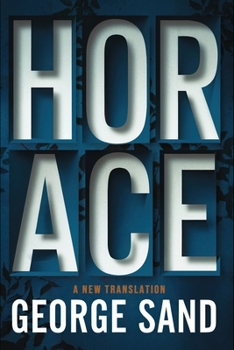
Horace: A New Translation

Horace Dumontet arrives in Paris from the provinces at nineteen, full of republican ideals and literary ambitions, with his sister's dowry financing his education and his parents' hopes financing his vanity. He is charming, confident, and almost entirely without discipline. He claims to despise bourgeois mediocrity. He gambles, borrows, spends, and performs the drama of his life in the manner of a man who has mistaken style for substance.
His story is told by Th ophile, a medical student who lives in the Latin Quarter with his mistress Eug nie and sees through Horace from their first conversation. He befriends him anyway. He continues to make excuses for him. He is not sure, even at the end, why.
Into the world that Th ophile inhabits - a world of Saint-Simonian idealism, working-class solidarity, cholera wards, and genuine republican commitment - Horace arrives like a distorting mirror. Around him: Marthe, a grisette and former barmaid fleeing a brutal husband, whose survival of Horace's abandonment - she becomes pregnant; he disappears - was the novel's central scandal. Eug nie, whose clarity about Horace is never shaken and who is never allowed by the novel to be merely decorative. Jean Laravini re, the working-class republican who goes to the barricades of June 1832 at the Clo tre Saint-Merri when the moment comes. Paul Ars ne, the brilliant art student who gives up his vocation because his friends need him to earn. And the Vicomtesse L onie de Chailly - drawn from life, from Sand's former friend Marie d'Agoult - who seduces Horace because his admiration flatters her and ruins his reputation when it stops.
Serialized in La Revue ind pendante from November 1841 through March 1842 and published in book form that year, Horace scandalized its original audience not for its politics but for its refusal to punish Marthe: a woman who had lovers, bore a child without marriage, and was not, in Sand's telling, destroyed by any of it. The grisette who survived, who was helped, who ultimately prospered - this was a more radical proposal than anything Horace manages in three volumes of republican speeches.
Not translated into English until 1995, Horace belongs to Sand's most politically explicit period and remains one of the sharpest portraits of a certain kind of man: charming, intelligent, incapable of genuine commitment, and genuinely surprised when the world declines to confirm his opinion of himself.
Customer Reviews
ThriftBooks ® and the ThriftBooks ® logo are registered trademarks of Thrift Books Global, LLC
