


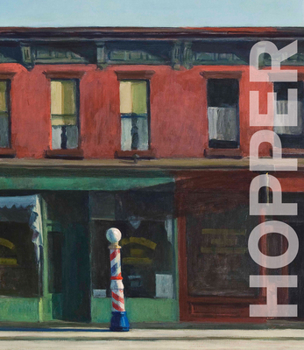
Hopper
No Customer Reviews

Published with R union des Mus es Nationaux - Grand Palais.
Edward Hopper is as quintessentially American as Jackson Pollock or Andy Warhol. Like them, his imagery has reached far beyond the realm of art to impact on our culture in the broadest terms, so that we see early twentieth-century America through his work, as much as within it. The painter Charles Burchfield attributed Hopper's success to his "bold individualism," declaring that "in him we have regained that sturdy American independence which Thomas Eakins gave us." Hopper's art was profoundly of its time, both in its expression of the subtle melancholies of modern life and in its deeply cinematic qualities--perhaps Hopper's greatest gift was his treatment of light--to which directors from Alfred Hitchcock to Wim Wenders have paid homage.This volume presents a definitive Hopper monograph. Published for a massive retrospective at the Museo Thyssen-Bornemisza in Madrid, and the Grand Palais in Paris, it approaches Hopper's relatively small oeuvre in two sections. The first covers the artist's formative years from approximately 1900 to 1924, examining a selection of sketches, paintings, drawings, illustrations, prints and watercolors, which are considered alongside works by painters that influenced Hopper, such as Winslow Homer, Robert Henri, John Sloan, Edgar Degas and Walter Sickert. The second section considers the years from 1925 onwards, addressing his mature output through chronological but thematic groupings. Comprehensive in its scope, with a wealth of color reproductions, Hopper is the last word on the artist.
Format:Hardcover
Language:English
ISBN:1935202871
ISBN13:9781935202875
Release Date:September 2012
Publisher:Distributed Art Publishers (DAP)
Length:366 Pages
Weight:4.64 lbs.
Dimensions:1.4" x 9.9" x 11.7"
Customer Reviews
0 rating
Copyright © 2026 Thriftbooks.com
Terms of Use | Privacy Policy | Do Not Sell/Share My Personal Information | Cookie Notice | Cookie Preferences | Accessibility Statement
ThriftBooks ® and the ThriftBooks ® logo are registered trademarks of Thrift Books Global, LLC
ThriftBooks ® and the ThriftBooks ® logo are registered trademarks of Thrift Books Global, LLC
