


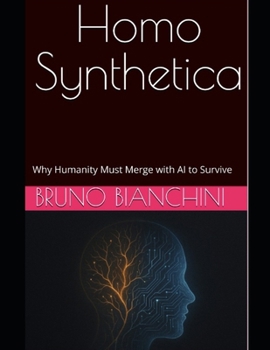
Homo Synthetica: Why Humanity Must Merge with AI to Survive

Homo Synthetica is a landmark work of speculative non-fiction that fundamentally reframes the global conversation about artificial intelligence. It argues that the current trajectory of silicon-based AI-the race to build ever-larger, energy-devouring models-is a thermodynamic, economic, and philosophical dead end. This "silicon mirage," the book contends, is not our salvation but a gilded path to ecological and civilizational ruin.
The book's core, paradigm-shifting thesis is that humanity's survival and future evolution depend on a "biocomputing pivot." Instead of trying to escape our biology, we must merge with it. The author makes a powerful, evidence-based case for a new technological era based on the fusion of human biology with AI, harnessing the unparalleled energy efficiency and adaptive genius of living neural computation (e.g., neural organoids).
Structure and Content:
Homo Synthetica is meticulously structured to guide the reader from a powerful critique of the present to a visionary-and practical-manifesto for the future.
Part I: The Mirage of Silicon deconstructs the unsustainable "furnace" of modern AI, exposing its hidden ecological, geopolitical, and cognitive costs.
Part II: Alchemy of Minds illuminates the revolutionary science making the merge possible, translating complex topics like iPSC reprogramming, organoid cultivation, and brain-computer interfacing into accessible, compelling prose.
Part III: Anthropology of Homo Synthetica explores the profound societal consequences of this shift, from the birth of "neurocapitalism" to the fracturing of politics under cognitive inequality.
Part IV: Moral Labyrinths confronts the deep ethical challenges head-on, including machine consciousness, cognitive rights, and the potential for a new biological caste system.
Part V: Chronicles of Tomorrow presents a series of plausible future scenarios, from a dystopian "Neurocracy" to a transcendent future where humanity guides its own evolution.
The book culminates in an Epilogue that serves as a powerful Manifesto for the Merge, offering ten actionable principles for the ethical and equitable development of this world-changing technology.
Market & Audience:
This book is positioned to capture the vast and growing audience grappling with the implications of AI, from readers of Yuval Noah Harari and Nick Bostrom to those engaged with the work of thinkers like Donna Haraway and David Chalmers. It distinguishes itself by rejecting both techno-optimist hype and doomsday fatalism, offering instead a "third way"-a challenging but ultimately hopeful and scientifically-grounded path forward. It is essential reading for policymakers, technologists, academics, and any intellectually curious reader seeking to understand the most important transition in human history.
Homo Synthetica is not just another book about AI; it is the book that defines the next chapter of the conversation. It is a bold, urgent, and profoundly original work that provides the new language and frameworks we desperately need to navigate our species' next evolutionary step.
Customer Reviews
ThriftBooks® and the ThriftBooks® logo are registered trademarks of Thrift Books Global, LLC
