


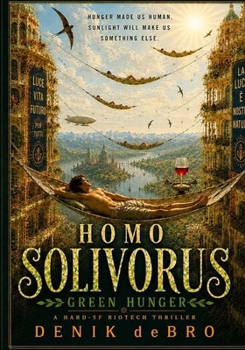
Homo Solivorus: Green Hunger

In the late twenty-first century, humanity makes a discovery that may end famine-and begin a new species.
While studying a remarkable sea slug capable of stealing chloroplasts from algae, marine biologist Dr. Mara Vale develops a revolutionary biotechnology that allows human cells to harvest a portion of their energy directly from sunlight. At first, the breakthrough appears miraculous. Food consumption falls. Hunger retreats. Nations celebrate what seems to be the greatest humanitarian achievement in history.
Then civilization begins to unravel.
As millions undergo chloroplast integration, agriculture contracts, food markets collapse, and governments race to control access to the world's most valuable resource: sunlight. Rooftops become sacred ground. Corporations patent metabolism itself. Religious movements proclaim the return of Eden. Militaries deploy photosynthetic soldiers capable of surviving with minimal supply chains.
But the most profound transformation is happening inside the human mind.
The altered-known as Solivorans-grow calmer, slower, and increasingly detached from the compulsions that once drove civilization. Their children are born different still. Among them is Naomi Vale, a second-generation child who may represent the first true member of a new human species. As political unrest erupts into global conflict and rival factions battle for control of the sky, humanity must confront an unsettling question:
If hunger shaped civilization, what happens when hunger begins to disappear?
Blending rigorous biological speculation, geopolitical realism, ecological philosophy, and evolutionary suspense, Homo Solivorus: Green Hunger explores a future where humanity's greatest adaptation may also be its greatest surrender.
For readers of hard science fiction, biotech thrillers, and thought-provoking speculative fiction, this is a story about evolution, survival, and the quiet transformation of what it means to be human.
Is humanity defined by intelligence-or by hunger?
Customer Reviews
ThriftBooks ® and the ThriftBooks ® logo are registered trademarks of Thrift Books Global, LLC
