


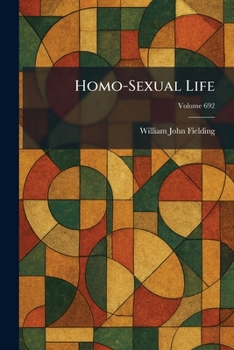
Homo-Sexual Life

"Homo-Sexual Life" is a significant historical exploration of human sexuality written by William J. Fielding during the early 20th century. This work offers a detailed look into the psychological and sociological perspectives of the 1920s, aiming to provide a rational understanding of same-sex attraction at a time when the subject was often shrouded in mystery and stigma.
Fielding examines the biological and social dimensions of sexual orientation, drawing upon the evolving scientific discourse of his era. The book discusses various theories regarding the origins of homosexuality and its presence throughout history, reflecting an effort to educate the general public on complex human behaviors through a lens of empathy and observation. As a document of early sexology, it highlights the transition from clinical categorization toward a broader social awareness.
For readers interested in the history of LGBTQ+ studies and the development of modern psychology, "Homo-Sexual Life" serves as an important primary source. It captures the intellectual landscape of the interwar period and provides valuable insight into how sexual identity was conceptualized, debated, and understood in the formative years of social science research.
This work has been selected by scholars as being culturally important, and is part of the knowledge base of civilization as we know it. This work was reproduced from the original artifact, and remains as true to the original work as possible. Therefore, you may see the original copyright references, library stamps (as most of these works have been housed in our most important libraries around the world), and other notations in the work.
This work is in the public domain in the United States of America, and possibly other nations. Within the United States, you may freely copy and distribute this work, as no entity (individual or corporate) has a copyright on the body of the work.
As a reproduction of a historical artifact, this work may contain missing or blurred pages, poor pictures, errant marks, etc. Scholars believe, and we concur, that this work is important enough to be preserved, reproduced, and made generally available to the public. We appreciate your support of the preservation process, and thank you for being an important part of keeping this knowledge alive and relevant.
Customer Reviews
ThriftBooks ® and the ThriftBooks ® logo are registered trademarks of Thrift Books Global, LLC
