


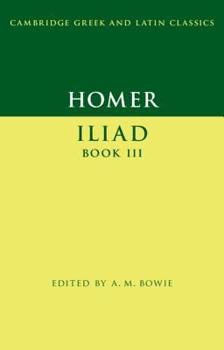
Homer: Iliad Book III

Select Format
Select Condition 
Book Overview
One of the most diverse books in the Iliad, Book III moves between intimate scenes in the heart of Troy and scenes serious and comic on the battlefield. It describes a major ritual in an elaborate oath-swearing, assigns a major role to divine intervention, introduces and characterises the main Trojan actors and reveals more about their Greek counterparts. The commentary discusses the styles of Homeric narrative, illustrating especially its economy and sophisticated handling of different time-scales. It situates the Iliad in its broad cultural and historical contexts, through consideration of the relationships between Greece and the Anatolian, Mesopotamian and ancient Indian cultures, particularly regarding shared story-patterns and ritual activity. An account is given of Troy's relationships with the Hittite empire and the vexed question of the historicity of the Trojan War. Also provided is a full historical account of Homeric language. The edition will be indispensable for students and instructors.
Format:Paperback
Language:English
ISBN:1107698022
ISBN13:9781107698024
Release Date:October 2019
Publisher:Cambridge University Press
Length:206 Pages
Weight:0.60 lbs.
Dimensions:0.4" x 5.5" x 8.7"
Customer Reviews
1 rating
The ground is dark with blood.
Published by bernie4444 , 2 months ago
With many books, translations are negligible, with two obvious exceptions: one is the Bible, and surprisingly, the other is The Iliad. Each translation can give a different insight and feel to the story. Everyone will have a favorite. I have several.
There are partial translations that are worth reading, but as with any abridgment or incomplete Iliad, you will never know what is missing.
Our story takes place in the ninth year of the ongoing war. We get some introduction to the first nine years, but they are just a background to this tale of pride, sorrow, and revenge. The story will also end abruptly before the end of the war.
We have a wide conflict between the Trojans and Achaeans over a matter of pride; the gods get to take sides and many times direct spears and shields.
Although the more focused conflict is the power struggle between two different types of power. That of Achilles, son of Peleus and the greatest individual warrior, and that of Agamemnon, lord of men, whose power comes from his position.
We are treated to a blow-by-blow inside story as to what each is thinking and an unvarnished description of the perils of war and the search for Arête (to be more like Aries, God of War).
Next, before reading the Odyssey, you will want to bridge the gap with “The War at Troy: What Homer Didn't Tell” by Quintus of Smyrna.
Copyright © 2026 Thriftbooks.com Terms of Use
| Privacy Policy | Do Not
Sell/Share My Personal Information | Cookie Policy | Cookie Preferences | Accessibility Statement
ThriftBooks® and the ThriftBooks® logo are registered trademarks of Thrift Books Global, LLC
ThriftBooks® and the ThriftBooks® logo are registered trademarks of Thrift Books Global, LLC
