


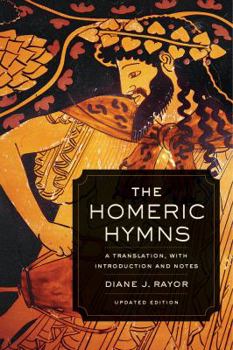
The Homeric Hymns: A Translation, with Introduction and Notes


Select Format
Select Condition 
Book Overview
The Homeric Hymns have survived for two and a half millennia because of their captivating stories, beautiful language, and religious significance. Well before the advent of writing in Greece, they were performed by traveling bards at religious events, competitions, banquets, and festivals. These thirty-four poems invoking and celebrating the gods of ancient Greece raise questions that humanity still struggles with-questions about our place among others and in the world.
Known as "Homeric" because they were composed in the same meter, dialect, and style as Homer's Iliad and Odyssey, these hymns were created to be sung aloud. In this superb translation by Diane J. Rayor, which deftly combines accuracy and poetry, the ancient music of the hymns comes alive for the modern reader. Here is the birth of Apollo, god of prophecy, healing, and music and founder of Delphi, the most famous oracular shrine in ancient Greece. Here is Zeus, inflicting upon Aphrodite her own mighty power to cause gods to mate with humans, and here is Demeter rescuing her daughter Persephone from the underworld and initiating the rites of the Eleusinian Mysteries.
This updated edition incorporates twenty-eight new lines in the first Hymn to Dionysos, along with expanded notes, a new preface, and an enhanced bibliography. With her introduction and notes, Rayor places the hymns in their historical and aesthetic context, providing the information needed to read, interpret, and fully appreciate these literary windows on an ancient world. As introductions to the Greek gods, entrancing stories, exquisite poetry, and early literary records of key religious rituals and sites, the Homeric Hymns should be read by any student of mythology, classical literature, ancient religion, women in antiquity, or the Greek language.
Known as "Homeric" because they were composed in the same meter, dialect, and style as Homer's Iliad and Odyssey, these hymns were created to be sung aloud. In this superb translation by Diane J. Rayor, which deftly combines accuracy and poetry, the ancient music of the hymns comes alive for the modern reader. Here is the birth of Apollo, god of prophecy, healing, and music and founder of Delphi, the most famous oracular shrine in ancient Greece. Here is Zeus, inflicting upon Aphrodite her own mighty power to cause gods to mate with humans, and here is Demeter rescuing her daughter Persephone from the underworld and initiating the rites of the Eleusinian Mysteries.
This updated edition incorporates twenty-eight new lines in the first Hymn to Dionysos, along with expanded notes, a new preface, and an enhanced bibliography. With her introduction and notes, Rayor places the hymns in their historical and aesthetic context, providing the information needed to read, interpret, and fully appreciate these literary windows on an ancient world. As introductions to the Greek gods, entrancing stories, exquisite poetry, and early literary records of key religious rituals and sites, the Homeric Hymns should be read by any student of mythology, classical literature, ancient religion, women in antiquity, or the Greek language.
Format:Paperback
Language:English
ISBN:0520282116
ISBN13:9780520282117
Release Date:March 2014
Publisher:University of California Press
Length:192 Pages
Weight:0.73 lbs.
Dimensions:0.5" x 5.5" x 8.2"
Customer Reviews
4 ratings
Great!
Published by Thriftbooks.com User , 17 years ago
It is a great read; highly recommend it if you are interested in this sort of topic.
For the Pagan book shelf
Published by Thriftbooks.com User , 18 years ago
Every Pagan ought to have some Homeric Hymns just to see how our Gods were venerated in another time and place. Homer is a beautiful poet and a great inspiration for writing our own, modern poems of devotion. Too often we spent time asking for things and not enough time expressing our love and appreciation for the powers we worship. Reading this might help you find a key to opening your own door to such amazement of our Gods and Goddesses that we find inspiration to give back to them. I gave it 4 stars only because I can't relate to many of the Deities as I am Celt based.
up-to-date, page-turning translation, superb notes & intro!
Published by Thriftbooks.com User , 21 years ago
These dynamic translations will interest both beginners and more advanced readers, whether to read these as poetry and great stories, for their importance in World Literature, or their particular relation to classical antiquity. The hymns are immensely readable in Rayor's smooth and engaging translations, and the length of the hymns, and their appeal to myth, makes them really perfect for classroom use. Readers will be fascinated with their speculations on the origins, powers, and mishaps of the gods and goddesses, and they provide a great take-off point for writing assigments, in my classes. Rayor's notes are clear, to the point, giving just enough detail for readers who want more, and signalling where we can look further. The text throughout is well-informed by recent anthropological approaches that have expanded knowledge of ancient Greek culture, evident in the valuable introduction and notes, which attend to the interrelation of literature, folklore, religion, and geography. Rayor's introduction adopts a practical-minded, functionalist approach to literary problems such as genre and authorship, describing a hymn as a poem of praise, sometimes narrative, addressed to a god, and noting the importance of oral performance in Greek culture. I took personal delight in the maps and glossary, whose easy-to-follow pronounciation guide anticipates and lays aside the uncertainties about proper names that many students find to be the greatest single obstacle to the Hymn and to classics. Casual readers will appreciate the clarity and accuracy of the language, with its fast-paced readability: the English of the hymns neither extrapolates nor subtracts from the original texts, balancing the desire for accuracy with creating a translation that is at once concise and musical. The introduction is clear and the bibliography offers a well-balanced selection of recent criticism. Of particular value are the the notes, which point to additional ancient and contemporary sources, always stressing the poems' contexts in poetic performance and religious worship in the ancient world.
Ian Myles Slater on: An Established Favorite
Published by Thriftbooks.com User , 22 years ago
The Athanassakis translation of the "Homeric Hymns" -- a somewhat disparate collection of narratives, possible opening invocations for performances of longer poems, and a mix of what seem to be actual religious documents and literary exercises -- displays both literary grace (in the verse-line translations), and scholarly explication (in the introduction, and in the accompanying notes to the individual hymns). [In his 2004 revised edition -- my review is of the original 1976 publication -- the translator continues to insist he was not aiming at producing poetry. It is indeed not formal English verse, but after decades of use I still find his translation not only readable but exceptionally attractive, and at least poetic, and not just by comparison to the old Evelyn-White translation.] The poems are described as Homer's in the manuscript tradition, in which they are offered together with hymns by historical poets, but also some attributed to the mythical Orpheus. They are in the dactylic hexameter line of the Homeric epics, which in some of them is employed as a lyric meter -- a somewhat astonishing idea to those who know the "Iliad" and the "Odyssey." Athanassakis does a wonderful job of producing consistently attractive English versions, while attempting to adhere closely to the original. (I have no claims to real scholarship in this, but I once took the trouble to work through passages against the corresponding lines in a Greek text, with the help of the Liddel- & -Scott "Lexicon" and several grammars.) After a long period of neglect on the part of translators into English, this group of poems has been translated in both verse and prose a number of times in recent decades. This volume first appeared at about the same time as translations by the poet Charles Boer (extremely "modern") and by Thelma Sargent in the Norton Library (to mention those still in print). These lacked the helpful apparatus (although Sargent could probably have provided something similar). The later Shelmerdine translation, in the Focus Classical Library series, is very extensively annotated, but is aimed at readers completely unfamiliar with Greek myth and literature. (In other words, a good textbook in a world in which the "classics" have dropped out of pre-collegiate courses.) Among the crop of *very* recent translations, by Cashford (Penguin Classics, with notes by Richardson), by Crudden (Oxford World's Classics), and (in a Loeb Classical Library bilingual edition) by M.L. West) [and now (2004) Diane Rayor], the work of Athanassakis seems to me to retain its place as both attractive and useful. Although Crudden, in particular, shows the benefit of another quarter-century of scholarship, his annotations often address other issues, and his notes on some of the hymns range from slim to nothing at all. How important are the notes? To a casual reader, they are of interest only if they help to make sense of a passage at hand. Some readers, however, will be using the boo
Copyright © 2026 Thriftbooks.com Terms of Use
| Privacy Policy | Do Not
Sell/Share My Personal Information | Cookie Policy | Cookie Preferences | Accessibility Statement
ThriftBooks® and the ThriftBooks® logo are registered trademarks of Thrift Books Global, LLC
ThriftBooks® and the ThriftBooks® logo are registered trademarks of Thrift Books Global, LLC
