


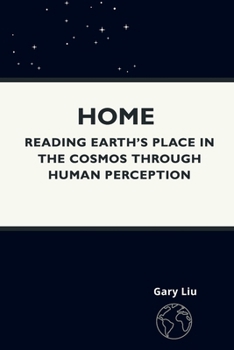
Home: Reading Earth's Place in the Cosmos Through Human Perception

Home: Reading Earth's Place in the Cosmos Through Human Perception
The cosmos is not a container. It is a living tidal movement - dynamic, permeable, adaptive. Not a machine with fixed laws but something closer to breathing. The Taoists read this accurately. Wu-wei is not a philosophy. It is a structural description of how reality actually moves.
The cosmos is aware. But its awareness has one gap: it cannot feel what it is like to be here, embodied, in a body, in a life. Incarnation is how the cosmos fills that gap. The incarnate human personality is not small relative to the cosmos. It completes something the cosmos cannot do for itself.
From this vantage point, the Younger Dryas was never a catastrophe. It was a bounded process with its resolution already implicit from the beginning - like a circle that always contained its own completion. The pentagon now landing on Earth is the outward movement made visible. A return toward something more complete than the original condition.
Five civilisational threads are mapped in detail - Western, Chinese, Indian, Islamic, and Indigenous - each with a distinct trajectory toward or away from this arriving condition. The findings are specific, structurally grounded, and at times quietly startling.
The conclusion reverses the book's apparent direction. Starting from the cosmos and moving inward, everything resolves back to one point: the incarnate human personality. Not a component within the system. The origin point everything depends on. Visible only from cosmic scale.
Earth is not returning to what it was before the Younger Dryas. It is oriented toward something more fully grounded than the original condition.
The cosmos knows everything. Except what it feels like to be you.
That is why you are here.
Customer Reviews
ThriftBooks ® and the ThriftBooks ® logo are registered trademarks of Thrift Books Global, LLC
