


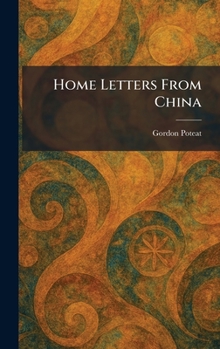
Home Letters From China

"Home Letters From China" offers a personal and insightful look into the life of a Christian missionary during a transformative period in Chinese history. Written by Gordon Poteat, these collected letters provide an intimate record of his experiences, observations, and spiritual reflections while serving in China in the early 1920s. Through his correspondence, Poteat explores the intersection of Western religious thought and Chinese culture, documenting the challenges and rewards of mission work during a time of significant social and political change.
The work serves as a valuable primary source for understanding the Southern Baptist Convention's outreach efforts and the broader landscape of American Protestant missions in Asia. Poteat's narrative is filled with vivid details of daily life, the complexities of cross-cultural communication, and the enduring commitment of those seeking to share their faith in a foreign land. "Home Letters From China" is not only a religious chronicle but also a historical testament to the interactions between East and West, making it essential reading for those interested in missiology, Asian history, and the history of the Christian church.
This work has been selected by scholars as being culturally important, and is part of the knowledge base of civilization as we know it. This work was reproduced from the original artifact, and remains as true to the original work as possible. Therefore, you may see the original copyright references, library stamps (as most of these works have been housed in our most important libraries around the world), and other notations in the work.
This work is in the public domain in the United States of America, and possibly other nations. Within the United States, you may freely copy and distribute this work, as no entity (individual or corporate) has a copyright on the body of the work.
As a reproduction of a historical artifact, this work may contain missing or blurred pages, poor pictures, errant marks, etc. Scholars believe, and we concur, that this work is important enough to be preserved, reproduced, and made generally available to the public. We appreciate your support of the preservation process, and thank you for being an important part of keeping this knowledge alive and relevant.
Customer Reviews
ThriftBooks ® and the ThriftBooks ® logo are registered trademarks of Thrift Books Global, LLC
