


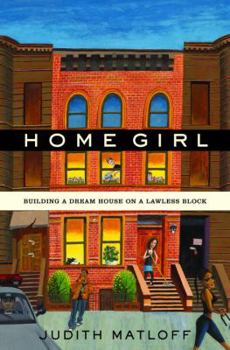
Home Girl: Building a Dream House on a Lawless Block

Select Format
Select Condition 
Book Overview
After twenty years as a foreign correspondent in tumultuous locales including Rwanda, Chechnya, and Sudan, Judith Matloff is ready to put down roots and start a family. She leaves Moscow and returns... This description may be from another edition of this product.
Format:Hardcover
Language:English
ISBN:1400065267
ISBN13:9781400065264
Release Date:June 2008
Publisher:Random House
Length:304 Pages
Weight:1.20 lbs.
Dimensions:9.5" x 1.0" x 6.5"
Customer Reviews
5 ratings
Taking the Plunge
Published by Thriftbooks.com User , 16 years ago
I actually ordered this book by mistake on my Kindle; I only wanted the free sample, but accidentally hit "buy." But I don't regret it--this was a thoroughly enjoyable book. Having lived in my share of harrowing neighborhoods in pre-gentrified Brooklyn and upper Manhattan during the eighties, I could understand what Matloff and her husband went through in the process of trying to make a home in a drug infested neighborhood. I particularly liked reading about her complicated relationship with Miguel, the drug dealer. Sleazy as the dealers are, they at least keep an eye on the street; I was actually reassured by their presence as I walked home from the subway at night. I enjoyed watching the youtube video that showed the house and some of the characters from the book. Her block looks pretty sedate now. Matloff is a funny and good-natured writer and "Home Girl" is a pleasure to read.
Transforming an Old Wreck Into a Real Inner-City Home
Published by Thriftbooks.com User , 17 years ago
Judith Matloff, a veteran war correspondent, moves back to NY after 20 years, with her Dutch husband (who bikes to work) and their Russian/African furniture (some of which arrives broken). She buys a long-empty brownstone in the West 140's in Manhattan, which at the time (1999) was going through "gentrification". After the violent worlds of South Africa and Chechnya, Harlem should be tame. Or is it? Matloff and her husband settle into the old house, and judging by the smell, it was once a massive toilet. But before the crack-heads moved in, it was the home of the neighborhood doctor. This part of Harlem was once home to the Black middle class, some of whom still live in the area. Unfortunately, the (mostly old) Black residents are despondent of ever seeing the neighborhood get better. The old music teacher across the street is a sad guy; he puts plastic flowers outside his home so the drug dealers can't kill them by urinating on them. Public urination is a major annoyance throughout the book; it seems that the men on her block (mostly teenage boys who haven't yet gone to jail) just piss where they are. Several of the houses are legally empty, but inhabited by crack-addict squatters. And if that's not bad enough, there's the "friendly neighborhood crackhead" who goes by the name of "Salami." I found this book funny because a lot of the things you fear the most never manifest themselves. The Matloffs never get attacked in the street. Their building is never broken into. "Salami" never does any of the things he threatens to do. The Matloffs get help along the way from an odd collection of characters when they refurbish their home. A lot of the guys are ex-addicts who probably see this building project as a way to repair the damage they did to themselves. After a while, you realize their motives; by fixing up this one home, more affluent buyers will come in, and the neighborhood's character will return. Americans tend to think of inner-city row houses with a certain nostalgia; cross the Sesame Street stoops with fond memories of old Brooklyn. But there are some drug-infested high-crime neighborhoods with plenty of these old row houses (brownstones are what we call them in NY). In most East Coast and Midwest cities, be they Detroit, Chicago, Cleveland, or St. Louis, row houses are crumbling shells full of rodents and robbers. But they are standing firm, and any building with a strong foundation and a sturdy structure can be transformed, for better or for worse.
I laughed my through this
Published by Thriftbooks.com User , 17 years ago
Home Girl is simply a must-read for all journalists who ever wondered what kind of life skills journalism might be proving them with, or anyone who has ever thought about buying a house in an "up and coming" urban neighborhood. I just finished it and I laughed through the whole thing. Judith (who taught some of my best classes at Columbia J-School) spent 20-some years reporting on, and living among, the most dangerous international war zones, but her goal of living a domestic settled life in New York City (Harlem) and raising a family turns out to be her biggest adventure yet. Some of us students sat around her huge dining room table for dinner; you won't even believe what she had to go through to get that thing here from Russia. It is insane. And I won't go into how she uses her war reporting skills to tame the local crack dealers. This little Youtube describes a bit about the book, but it's not even close to as funny or good as the real thing. Makes a great gift for a friend who's searching for a new home. http://www.youtube.com/watch?v=TOijhe5TfQo
From S. Krishna's Books
Published by Thriftbooks.com User , 17 years ago
I usually don't read a lot of non-fiction, but I've been making it a point to read more of it lately. When Julie at FSB Associates offered me the chance to review it, I was really excited - here was a memoir that seemed to have all the elements of the fiction books I so enjoy reading. It was fun and exciting, humorous and enjoyable, but also altogether shocking! I couldn't believe the obstacles Judith and her husband had to surmount in order to simply make their new home habitable. I read somewhere that the best memoirs are written by people who have previous writing experience. I think that definitely holds true for Home Girl: Building a Dream House on a Lawless Block. The book is suspenseful enough to keep the reader hooked but the need to build that suspense doesn't get in the way of the quality of the writing. It is definitely well-written and easy to read. I admired Matloff's bravery at buying a house in, basically, the worst part of Harlem, but I was sometimes surprised at her level of denial. I am fastidious about checking every detail and making sure everything is ok, so every time she rationalized something to herself, I inwardly cringed - I knew something bad was about to happen. In a fiction book, this would probably bother me. But for some reason, in a non-fiction book, it didn't. I felt like it spoke to the author's sincere and ardent desire to make a home, no matter the location or surroundings. She had to make the best of what she had and could afford, which in New York City, wasn't much. But Matloff turned her home around, and arguably helped turn her area of Harlem around; it is an incredible feat to read about and it took a lot of bravery and courage. One thing I really appreciated about the book was Matloff's honesty. On the rough days, she admits she may have made a mistake in buying the house. When she is scared, she says so but also bravely faces them head on. In the end, she and her husband realize that buying the house was a great thing, but it is nice to see her being honest about it throughout the renovation process. I really enjoyed Home Girl: Building a Dream House on a Lawless Block and definitely recommend it to anyone who think the premise sounds interesting. Usually, non-fiction books take me a long time to read because I find them to be more difficult than my regular fiction. However, that wasn't the case with this book; it flowed smoothly, and I think most people will find it reads just as quickly as any fiction book. It's definitely a worthwhile read! 4.5 stars rounded up to 5
Making a home on a 'lawless block'
Published by Thriftbooks.com User , 18 years ago
I was a little leary of this book at first as I am not one to read much non-fiction. And the memoirs I've read run the gamut from boring to extremely engaging and fun. I am pleased to say that Judith Matloff's story of her family's experience was very interesting and I thoroughly enjoyed it. Judith worked for years as a foreign correspondent living in a variety of other countries. After getting married in her late 30's and having two miscarriages, she starts longing to put down roots closer to her family. While her Dutch husband waits back in Russia for his visa, she moves into her mother's basement in New York and starts looking for a house. She ends up finding a 'home with potential' in West Harlem among the dealers and the crack addicts. This story tells of their journey with contractors, the neighbors, the dealers and many others. Her history of being a foreign correspondent blended well into relating the experience of moving into a 'lawless block' in New York. I worried for her, shook my head at her foolishness and how naive she was. But I also smiled with her choices on friends, the workers, and as she became a mom. And also as the 'lawless block' turned into something great. I recommend this book to all.
Copyright © 2026 Thriftbooks.com
Terms of Use | Privacy Policy | Do Not Sell/Share My Personal Information | Cookie Policy | Cookie Preferences | Accessibility Statement
ThriftBooks ® and the ThriftBooks ® logo are registered trademarks of Thrift Books Global, LLC
ThriftBooks ® and the ThriftBooks ® logo are registered trademarks of Thrift Books Global, LLC
