


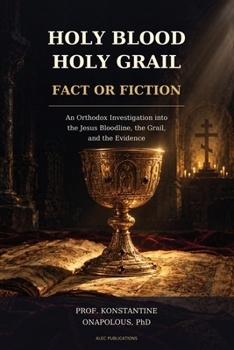
Holy Blood, Holy Grail

Was history concealed-or was a compelling story mistaken for evidence?
A secret bloodline descending from Jesus Christ. A hidden order guarding an extraordinary truth. Medieval kings, the Knights Templar, and the Holy Grail woven into a reconstruction of Christian history.
Holy Blood, Holy Grail presented readers with a provocative possibility. But how securely do its conclusions follow from its sources?
In Holy Blood Holy Grail: Fact or Fiction, Prof. Konstantine Onapolous, PhD, examines the historical claims and theological assumptions behind the bloodline hypothesis from an Orthodox Christian perspective.
Across sixteen chapters and 146 separate Analyses, this book follows the argument through the mysteries of Rennes-le-Ch teau, the Priory of Sion, the Merovingian dynasty, medieval Grail traditions, and the Gospel narratives. Each connection raises a question: does the evidence establish what the theory requires, or does the conclusion depend on speculation?
The investigation considers:
Rennes-le-Ch teau and B renger Sauni re: What can a mysterious narrative establish about a much larger historical claim?The Priory of Sion: Do the documents support the organization's alleged antiquity and influence?The Knights Templar: Where does institutional history end and a proposed secret tradition begin?The Merovingians: Can royal legends and genealogical assertions demonstrate descent from Jesus?The Holy Grail: Does literary and religious symbolism provide evidence of a biological bloodline?Jesus and Mary Magdalene: What do the cited texts say, and how far can their interpretation reasonably extend?Constantine and the early Church: Do claims about imperial power, Christian doctrine, and the biblical canon withstand examination?A compelling explanation still needs evidence.
The book examines the reasoning that connects one claim to another: appeals to unnamed authorities, arguments from silence, symbolic parallels, selective readings, and conclusions that reach beyond the sources offered to support them. It distinguishes the possibility of an event from evidence that it occurred-and criticism of a Christian belief from proof of an alternative history.
Its Orthodox perspective addresses the identity of Christ, the Incarnation, the Crucifixion, and the Resurrection, explaining why these are central to the Church's confession and why a proposed biological dynasty represents a fundamental theological departure.
Written for readers interested in Christian history, Orthodox apologetics, Grail traditions, and the relationship between evidence and belief, Holy Blood Holy Grail: Fact or Fiction invites a careful examination of an extraordinary historical argument.
Follow the claims. Examine the connections. Decide how much the evidence can bear.
Customer Reviews
ThriftBooks ® and the ThriftBooks ® logo are registered trademarks of Thrift Books Global, LLC
