


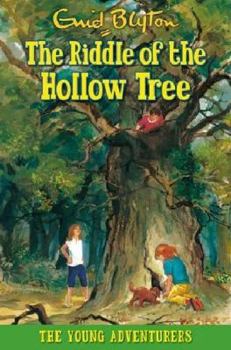
The Riddle of the Hollow Tree (Young Adventurers)

Select Format
Select Condition 
Book Overview
From one of Canada's best loved children's writers comes the enthralling tale of a brave young girl caught up in the American Revolutionary War. It is 1777 and Phoebe Olcott is thrown headlong into... This description may be from another edition of this product.
Format:Paperback
Language:English
ISBN:1841357405
ISBN13:9781841357409
Release Date:January 2009
Publisher:Award Publications Ltd
Weight:0.45 lbs.
Customer Reviews
5 ratings
Doestoevsky's Master Work
Published by Thriftbooks.com User , 18 years ago
What could have prompted me to first read "The Idiot" at age 13 on a beach vacation with my family I can not recall. What I do recall, however, that I was fully engrossed day after day in a world of ideas, people and places far beyond my experience. Having now just "re-read" it 39 years later (following Crime and Punishment and Brothers Karamazov), I know I couldn't possibly have digested all of its ideas at that age: atheism vs. Christianity; nihilism vs. a dying social order; Eros vs. charity; truth vs. artifice; id vs.ego and superego. And yet, I also sense I know what captivated me even then. The characters in this novel, though usually explained as symbolic of the ideas they represent, are yet the most vividly realized characters I had ever "read" then, and still. The real-time manner in which they are drawn and followed is as if the author simply recorded their actions and conversations as and where they happened. We get to know who these people are, not through narrative description, but, as if by "candid camera", observing what they say, withhold, do, and fail to do. What emerges are fascinating, at times frightening and at times affectionate portraits of real and troubled humans: Lizaveta, the flighty, but loving society mother; General Epanchin, the successful but utterly conventional man of the house; Aglaya, the childish but delightful beauty who resents her sister's and parents' expectation for her; Ganya, who wants money and love, but plays the wounded martyr while more obviously blaming his father for his failures at both; Ivolgin, the pathetic figure of an aging man who aches for dignity and respect but who's former glory is long gone and mostly imagined; and Lebedev, the likeable sycophant and name-dropper. The more central characters to the events, the murderously passionate Rogozhin, and the self-scorning beauty Nastasya, are more starkly drawn. But even those portraits are created not through direct thought narration or narrative description, but by the author's leading us to read between and behind the lines of their words, conversations with others, and public "displays". As for the Prince himself, he is often said to symbolize the human side of a Christ-like man. That, of course, is true; but (as can also be seen in Aloysha, the hero of The Brothers Karamazov), he is as much child-like as he is like a Christ. The Prince's honesty, naiveté, trust, and simple affection for those around him, are all qualities that he seems to maintain as a man because he is really only entering the "adult" world of social Petersburg after a long and sheltered upbringing among younger children in Switzerland. When he enters this tangled world of adult competition, insecurity, envy, ambition and intrigue, though much older, he's in the most essential ways still the child that was sent by his benefactor to Switzerland for help with his illness. One comes away with the strong impression (reinforced by the por
Great Children's Book: Hollow Tree House
Published by Thriftbooks.com User , 23 years ago
Very enjoyable story about a hard-hearted, mean-spirited stepmother married to an out-of-work, weak but well-meaning husband, and her unfortunate stepchildren who suffered the lashings of her tongue whilst under her tutelage. The quintessetial Enid Blyton story reminiscent of an era long passed by where kids played outdoors in the woods. Read an original First Edition in hardcover if at all possible.
Profound, Timeless Relevance
Published by Thriftbooks.com User , 24 years ago
The Idiot is often unfairly compared to Dostoyevsky's other masterpieces and, even though The Idiot usually comes out on the short end of any comparison, it is certainly my favorite. Although the narrative of The Idiot may ramble more than do some of Dostoyevsky's other books, I feel it is ultimately more profound.At its core, The Idiot is a character/society study although it also encompasses many religious and political aspects as well. The central character, Prince Myshkin, provides the contrast for all the other characters and is definitely a "Christ-like" figure, a man who embodies most perfectly the Christian ideals of selflessness and love.Prince Myshkin is a man who has suffered from mental illness since childhood. This illness has the curious effect of causing him to respond from his heart rather than from his head. In addition, Myshkin also suffers from a form of epilepsy that causes him to launch into tirades regarding the social ills of the day. As a Christ-like figure, Myshkin is in direct contrast to the other characters in the book who are all worldly and sophisticated, though somewhat cynical, aristocrats. Myshkin's extreme goodness also causes him to become entangled in various political and personal intrigues.Although completely good, Prince Myshkin in a fully realized character. One of the marvels of this novel is that Dostoyevsky managed to present Myshkin as a serious, rather than a comic, character. His goodness is not something we want to laugh at. There are many comic moments in the book, however, and most of them are provided through various financial and romantic entanglements.Although Prince Myshkin is the thread that links all the characters and aspects in the novel, he is not the only fully realized character; the others are also extremely well drawn. Dostoyevsky was fond of using real life incidents in his books and his notes tells us this is something he did in creating the characters that populate this book.Ultimately, The Idiot is a tragic book. Politically, it ridicules the shallow ideals of the Russian aristocracy, and, while Prince Myshkin's ramblings may seem comic, they are actually harsh criticism.Prince Myshkin was more than "a positively good man." He was a man who could see into the future and know what lay in store. Dostoyevsky's deep insight into the character of man makes The Idiot one of literature's most profound and timeless works.
A dark, tumultuous, complex work--one of D's greatest.
Published by Thriftbooks.com User , 26 years ago
Dostoevsky, that great tortured and feverish soul, wrote this novel after the onslaught of the Nihilists in Russian arts and letters. He felt he was waging a war against the crude and unfeeling Western materialism of the day; he was battling what he saw as a holy war. While authors like Turgenev and Tolstoy regarded the expanding West with (fairly) open arms, Dostoevsky feared it would cause a religious crisis, where faith in Christ was extinguished and ignorance, vanity, and greed would overcome.This is a towering, exciting novel--perhaps not as great as "Crime & Punishment" or "Brothers Karamazov"--it contains some of his most penetrating insights into religious faith, human compassion, despair, and insanity. Prince Myshkin is of course one of literature's great characters, a Christ-like young man caught up in the treachery of the aristocratic lives of the Yepanchins. The other two main characters, Rogozhin and Nastasya Filippovna, along with Myshkin, form a powerful triangle that, despite their being "off-stage" for much of the novel, drive this novel to its tragic, unavoidable climax.I do not, however, recommend this book to first time Dostoevsky readers; that should be "Notes from Underground" or "Crime and Punishment." The ideas Dostoevsky explores here need some context and understanding; they may leave the inexperienced reader a bit confused. At least that was my experience! After understanding him and his concerns, this novel cracked wide open. It is a darkly spiritual work, as are all of his; it is also quite disturbing. When young Ippolit describes the Hans Holbein painting "Christ in the Tomb" that adorns the cover of the Oxford edition, we see into the darkest reaches of despair and hopelessness. Indeed, the painting is a Christ that is unresurrected, one that is rotting flesh and cannot, in Dostoevsky's scenario, save humankind. This thought terrifies Rogozhin, Myshkin... and Dostoevsky himself.What a stunning achievement this work is. I am in awe of it. Simply: Read it.
My favorite book by my favorite author!
Published by Thriftbooks.com User , 26 years ago
This is the novel where Dostoevsky's ability as an artist to create fascinating characters reach it's pinnacle. How can you read this novel and not love the Prince Myshkin, with his childlike innocence juxtaposed against his complete mastery into the inner psychologies of people, or not fall in love with Aglaia, the sensitive and mercurial soul that protects herself behind a wall of cynicism and pride? Dostoevsky somehow casts his spell, whereby the the reader is lead into another world populated with seemingly fantastic and insane characters, who nevertheless seem absolutely real. His uncanny insights into the depths of psychology are incredibly trenchant and almost super-human. Nietschze said of Dostoevsky that he is the only psychologist whom he ever learned anything from. So absolutely true! Who else wrote with such insight about people with self destructive tendencies(Natashya), subconscious desires, and the irrational contradictions of the conscious and subconscious. If you read this novel and do not come away with new insight and a better understanding of the psychological workings of others around you, either you are Freud come back from the dead or incredibly dense!
Copyright © 2026 Thriftbooks.com Terms of Use
| Privacy Policy | Do Not
Sell/Share My Personal Information | Cookie Policy | Cookie Preferences | Accessibility Statement
ThriftBooks® and the ThriftBooks® logo are registered trademarks of Thrift Books Global, LLC
ThriftBooks® and the ThriftBooks® logo are registered trademarks of Thrift Books Global, LLC
