


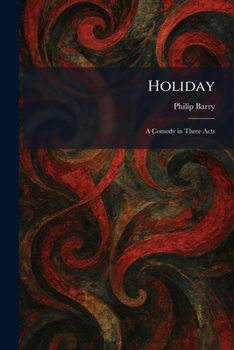
Holiday: A Comedy in Three Acts

"Holiday: A Comedy in Three Acts" is a sparkling comedy of manners that examines the tensions between the pursuit of wealth and the pursuit of happiness in 1920s American high society. The play follows Johnny Case, an ambitious young man who has made a sudden fortune and intends to take a long "holiday" to find the meaning of life. However, his plans clash with the expectations of his fianc e's wealthy and status-conscious family, particularly her father. As Johnny navigates the pressures of the elite Seton family, he finds an unexpected ally in his fianc e's sister, Linda, who shares his desire for a life free from the suffocating constraints of the upper class.
Philip Barry's sharp dialogue and witty social commentary highlight the conflict between materialistic success and personal integrity. "Holiday: A Comedy in Three Acts" remains a classic of the American stage, offering a timeless exploration of individuality and the true value of leisure. Its blend of humor and poignant insight captures a pivotal moment in social history, making it a definitive work of early 20th-century drama.
This work has been selected by scholars as being culturally important, and is part of the knowledge base of civilization as we know it. This work was reproduced from the original artifact, and remains as true to the original work as possible. Therefore, you may see the original copyright references, library stamps (as most of these works have been housed in our most important libraries around the world), and other notations in the work.
This work is in the public domain in the United States of America, and possibly other nations. Within the United States, you may freely copy and distribute this work, as no entity (individual or corporate) has a copyright on the body of the work.
As a reproduction of a historical artifact, this work may contain missing or blurred pages, poor pictures, errant marks, etc. Scholars believe, and we concur, that this work is important enough to be preserved, reproduced, and made generally available to the public. We appreciate your support of the preservation process, and thank you for being an important part of keeping this knowledge alive and relevant.
Related Subjects
DramaCustomer Reviews
ThriftBooks ® and the ThriftBooks ® logo are registered trademarks of Thrift Books Global, LLC
