


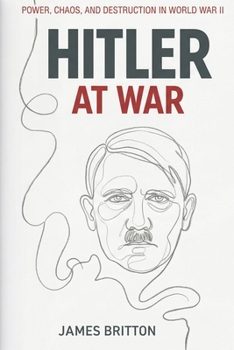
Hitler At War: Command, Myth and Catastrophe: A short History series

What if Adolf Hitler wasn't the all-powerful dictator history remembers?
For decades, Hitler has been portrayed as a master of total control-a leader who directed every aspect of Nazi Germany with ruthless precision. But a growing number of historians argue something very different.
They claim Hitler was a surprisingly weak dictator.
In Hitler: The Weak Dictator, James Britton explores one of the most important debates in modern history. Drawing on the work of leading historians such as Ian Kershaw and Hans Mommsen, this book reveals a regime defined not by strict control, but by chaos, rivalry, and competing authorities.
Instead of issuing clear orders, Hitler often avoided decisions, encouraged overlapping power structures, and allowed subordinates to interpret his will. The result was a system where initiative, ideology, and competition drove policy-often with devastating consequences.
And yet, despite this apparent weakness, Hitler led Germany into total war, reshaped Europe, and maintained extraordinary loyalty from both elites and ordinary citizens.
So how did he do it?
This short, accessible history uncovers the paradox at the heart of Nazi Germany: a dictatorship where disorder became a source of strength, and where power did not require control.
Perfect for readers interested in World War II, political power, and modern history, this book offers a clear and thought-provoking perspective on one of history's most studied figures.
Related Subjects
HistoryCustomer Reviews
ThriftBooks ® and the ThriftBooks ® logo are registered trademarks of Thrift Books Global, LLC
