


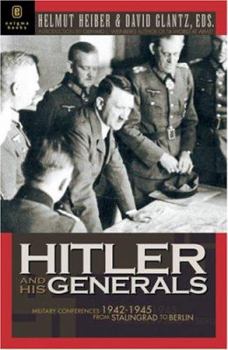
Hitler and His Generals: Military Conferences 1942-1945


Select Format
Select Condition 
Book Overview
The military conferences that Hitler had twice daily with his staff, where he directed the war, were transcribed by stenographers from 1942 to 1945 in the bunker. These authentic documents are the... This description may be from another edition of this product.
Format:Hardcover
Language:English
ISBN:192963109X
ISBN13:9781929631094
Release Date:September 2002
Publisher:Enigma Books
Length:1158 Pages
Weight:3.60 lbs.
Dimensions:9.3" x 2.4" x 6.3"
Customer Reviews
5 ratings
Good Substance, Deserves Better Presentation
Published by Thriftbooks.com User , 20 years ago
This is a valuable primary source that has been lacking in English--previously only less complete or German-only versions were published. The editing and transcription and restoration of these transcripts was superb, better than should be expected, and the translation into English, sometimes sloppily done in other works, is just exactly perfect here. The minuses concern what comes before and what comes after. Gerhard Weinberg's sputtering, foaming at the mouth, introduction and comments throughout are execrable. David Glantz's endnotes to the transcripts mean well and could be excellent, but obviously were not at all edited. There is a wealth of information back there (Glantz is a master at this subject), but almost as much dis-information in the form of typos and similar mistakes that any decent editing would/should/will (hopefully?) catch and correct? Ditch the Weinberg rants and edit the Glantz endnotes and this gets five stars--and even so it remains an indispensable primary source for WW2 history.
Hitler in his own words
Published by Thriftbooks.com User , 20 years ago
This is an absolutely indispensable book for anyone who wants to understand how military decisions were made in Nazi Germany, and what Adolf Hitler was really like as a Supreme Commander. I've been reading books about the Nazis for 25 years and this is the first one which literally puts you, the reader, at "Der Fuhrer's" elbow as he directs his war. "Hitler & His Generals" is a collection of the surviving transcripts of Hitler's military conferences from the very end of 1942 until the last days of the war in April of 1945. It contains all the transcripts included in the 1956 book "Hitler Directs His War" and new ones subsequently discovered. It also has extremely elaborate end notes (hundreds of pages long) packed with charts, biographical info, history, the context of certain remarks, and so on. A truly massive work more than 1,000 pages in length. Hitler had ordered the presence of sternographers at his situation conferences during the Stalingrad campaign, when his relationships with his generals were at an all-time low. He believed his orders were not being carried out as he directed and planned to use the transcripts to write his post-war history. 99% of them were destroyed at the end of the war, but the survivors make a fascinating picture of the dictator in action. The Hollywood version of Hitler is of the carpet-chewing maniac hurling abuse and nonsensical orders at quailing generals. General Guderian in particular described Hitler's tantrums in his own memiors, and unprovoked outbursts of rage were also frequently alluded to by Field Marshal Keitel and others. The transcripts show a different picture of Hitler, the one painted by Speer, who described a leader who radiated calm during the deepest crisis and used sarcasm rather than screaming to express his displeasure. They tend to support Field Marshal Manstein's theory that Hitler's tantrums were much less frequent than is believed and probably simulated (a classic case of the bully who knows who to pick on and who to leave alone). The transcripts show a lot about Hitler's leadership style and personality. He seemed to have no "long view" and immersed himself soley in tactical details. He possessed tremendous technical knowledge and liked to expound about weaponry, ballistics, construction, and other subjects of a similar nature. His insistence on holding every inch of ground was clearly predicated on a desire to keep the war "on the periphery of the Reich" and he was often worn down and disgusted by demands for "flexible defense" which he equated with retreat. Hitler frequently digressed into political, ideological and historical discussions which are of great interest to the reader (though they probably bored the hell out of his listeners). Expressions which show his philosophy of life abound -- terror can only be broken by terror, intellect is less important than will-power and strength of character, perserverance and toughness win wars, and so on. Most interestingly, he ofte
IMPORTANT PIECE OF WORK
Published by Thriftbooks.com User , 20 years ago
As with other reviewers I found this book to be largely bland and boring. I am sure similar transcripts of American, British, and Soviet conferences (I would love to see some of the Soviet transcripts with Stalin if any exists) would also be pretty bland. The vast majority of the transcripts were destroyed at the end of the war and these 700+ pages represents only a small minority of the conferences. There are few highlights. The first conference in the book is about the time a crisis was developing in Stalingrad. Shortly thereafter it jumps to a conference where word has just come in stating Field Marshal Paulus had surrendered and the participants were speculating over whether that was true and the Fuhrer declaring he would never appoint another field marshal. (He did appoint others however after that declaration). The transcripts included some planning sessions for what became the Battle of Kursk -- the largest tank battle in history -- and the Germans trying to respond to the overthrow of Mussolini in Italy. There were some planning sessions before and during the Battle of the Bulge. Probably the most interesting remnants, though, were the last conferences in the Berlin Bunker in late Apr 1945. But other key transcripts were missing and are probably gone forever. These include the D-Day invasion, the attempted assassination on 20 Jul 1944, and his last conference before taking his life. But for the most part I would guesstimate that about 90 percent of the book was about troop movements, weapons, and other mundane issues that are discussed at military conferences and briefings -- and not just German conferences in WW II. These transcripts do not record the actions or atmosphere these conferences transpired in. There are no references to the Fuhrer jumping on a table and screeching obscenities and threats at his staff with veins popping out of his neck. These are just the spoken words of the Fuhrer and his staff in black and white. Most of what his generals and other senior military staff wrote after the war blamed him for what happened to Germany but these transcripts show that he was not quite the lunatic they made him out to be. In some respects these transcripts offer some vindication for Hitler. Historically he comes off as some kind of lunatic who destroyed his country by refusing to work with his generals. Although he did destroy his country -- and millions of other Europeans along with it -- he comes off as mostly a fairly knowledgeable person. For example the historical image of the man is somebody who in the face of impossible odds refused to order troops to withdraw to better positions. Yet throughout this book Hitler is aware of the situation at the front and often concurs with withdrawals and retreats -- something the Germans did a lot of after 1942. There were 2029 footnotes that were distracting but mostly important for the reader. There are references to personalities and events that would mean nothing t
Inside look at Hitler's personal command
Published by Thriftbooks.com User , 22 years ago
To be perfectly honest, this book is not for casual reader. The transcripts of Hitler's military conferences might be interesting for selective folks who got a lot of military history background on World War II but for majority of casual readers out there, the book would make a better pillow then a reading material. (some of materials were released in other publications but this book claims to have it all.)Having said that, for folks like me who do have good background on World War II, I found the book to be quite interesting and bit annoying. Like the previous reviewer, I was bit taken back by the fact that some of the most interesting conferences were not there and it was hard to assess the mood of the people at those conferences. It was plain amazing how trivial Hitler got in these conferences. I don't think no other commander-in-chief during that war ever got so micro-managing as Hitler got as the book showed. Of course, some part of the book was rather slow but it was interesting to see who was the toady and who wasn't at these conferences. Its a thick book and not very fast reading material. But for hard core World War II reader, this book should be read.
An important primary source for WW2 Germany
Published by Thriftbooks.com User , 22 years ago
This book is a compilation of conference transcripts from the daily military conferences between Hitler, his staff, and other members of the Nazi hierarchy. Unfortunately for the reader, many of these conference minutes exist in a fragmentary form. Primarily, this was due to destruction after the war, but also that these were taken down in real time; and whatever the stenographer heard is what was recorded. The editors have done an impressive job with filling in the gaps where possible: adding background information on personalities and operations often referred in an off-hand manner. (Not surprising given that the attendees would have the continuity of background from ongoing discussions not recorded here.) The gaps are the real drawback here: conference minutes for the most critical of times such as Normandy and immediately after the 20 July 1944 assassination attempt are missing. Also, following the flow of discussion is sometimes problematic at best. Additionally, one cannot often tell whether the conference is discussion or Hitler's infamous rants. But for someone determined to slog through, Hitler's control of even the most trivial issues, (for example which unit should get the next tank replacements) is brought into focus. His yes-men, Halder and Jodl also clearly show their support of even the most idiotic of decisions.Obviously such a primary source document isn't for someone with a general interest in World War II. But a reader with familiarity with Hitler's Germany and military operations would find this worthwhile. Highly recommended.
Copyright © 2026 Thriftbooks.com Terms of Use
| Privacy Policy | Do Not
Sell/Share My Personal Information | Cookie Policy | Cookie Preferences | Accessibility Statement
ThriftBooks® and the ThriftBooks® logo are registered trademarks of Thrift Books Global, LLC
ThriftBooks® and the ThriftBooks® logo are registered trademarks of Thrift Books Global, LLC
