
Skip to content
Scan a barcode
Scan
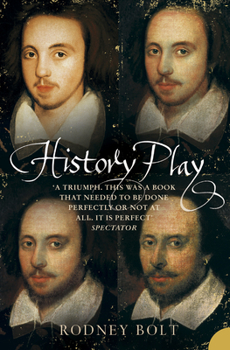
Paperback History Play: The Lives and After-Life of Christopher Marlowe Book

ISBN: 0007121245

ISBN13: 9780007121243

History Play: The Lives and After-Life of Christopher Marlowe

Select Format

Select Condition ThriftBooks Help Icon

Recommended

Format: Paperback

Condition: Like New

$11.59
Save $3.40!
List Price $14.99
Almost Gone, Only 1 Left!
Save to List

Book Overview

What if Christopher Marlowe staged his own death, fled to the Continent and went on to write the works we now attribute to Shakespeare?

'About anyone so great as Shakespeare, it is probable that we can never be right; and if we can never be right, it is better that we should from time to time change our way of being wrong.' T. S. Eliot

Mark Twain likened writing the biography of Shakespeare to reconstructing the skeleton of a brontosaurus - using 'nine bones and six hundred barrels of plaster of Paris'. We work with a handful of facts and a pile of conjecture. All biographies of Shakespeare, from the wayward to the academic, use the same few-score hard facts kneaded together with legend, then leavened by a dash of zeitgeist and a large dollop of author's imagination. Poems and plays are plundered for booty, even by those who profess scepticism as to the inferences that can be drawn about the life from the work. Like statistics, quotations can be turned to very different facts.

This book is not, of course, an attempt to prove that Christopher Marlowe staged his own death, fled to the continent, and went on to write the work attributed to Shakespeare. It, however, playfully assumes that as its starting point, and swings the old bones around, viewing them from a different angle to build a different brontosaurus. It does so in a spirit of fun, and with the intention of a little saucy iconoclasm. Shakespeare's works are unassailable, and will survive any amount of subversion, but by playing with our commonplace history, Rodney Bolt argues that the quasi-religious idol the man has become is perhaps in need of the efforts of a wicked woodworm.

Where other writers have looked at the evidence and deduced a story, Bolt has imagined a story, then supported it with the same sparse evidence. At this distance, the difference between deduction and speculation is paper thin. The point of the take is not only to question our view of history and the validity of biography, but to show how people travelled, how cultures crossed, and how art gets made.

Customer Reviews

4 ratings

Very clever

The footnotes alone are worth the price of the book - very, very funny! Really gets you thinking about how scholars write Shakespeare biographies from very skimpy evidence. Marlowe's genius and absolutely fascinating life wonderfully captured by Bolt. Fun, educational, irreverent.

fiction, but what fun

Farfetched, but lots of fun to read. Very imaginative and I, for one, would be happy if it were true that poor Kit was not murdered, but lived on to create. I enjoyed the descriptions of the politics and personalities of the time, especially my favorite villain, Sir Robert Cecil.

Clever, witty, ENTERTAINING!

If you're a fan of Shakespeare, and want a way to experience the flavor of life in his times (Elizabethan England), there is no better book from the standpoint of entertainment and thought-provoking suppositions. Fiction? OF COURSE! And the author admits it. But what FUN! (This book has for me a lot of the exciting "you are there" of the film Shakespeare In Love: wildly informative and entertaining quasi-fantasy.)

A well-imagined alternative history

If you've ever been bemused by the fuss about who wrote the Shakespeare plays, this book will set you straight. The foreword reprints Sam Clemens' (aka Mark Twain's) inventory of all the positively known facts about Shakespeare, and it's a scanty list. Most striking is the fact that Will's children were illiterate, that he left no literary bequest but carefully distributed physical goods down to old furniture in his will, and that we know more about his life as a trader and bean counter than we do about his acting. Bolt takes as his premise that Shakespeare couldn't have written the plays attributed to him, and that he acted as a front for Christopher Marlowe who was writing from exile after narrowly escaping assassination; a stand-in died in his place in the infamous "tavern brawl". Bolt readily admits that this is a fiction, but argues that even supposedly reputable Shakespearean history is mostly invention, too. As he says in his Afterword: "Other writers have looked at the evidence and deduced a story; I have imagined a story, then supported it with the same sparse evidence." The book weaves a persuasive and instructive tapestry of Elizabethan life. (Bolt does a good job of signaling what's his invention, and what's based on accepted sources.) It gave me with a good sense of the intrigue and insecurity at the heart of the regime, of the making and staging of plays in that time and of the constant flux as people and ideas flowed freely across war-torn Europe. There are frequent references to, and reinterpretations of, Shakespearian poetry and plays, and many witty asides. I sense that I missed many of the puns, anagrams, and in-jokes, but they were done with such a light touch that this didn't bother me. My only quibble with the book is that Marlowe is a cardboard figure around whom the history turns. The peripheral characters are better drawn, from Shakespeare as a ambitious and venal minor talent, to Marlowe's friends and mentors in the spy world, to the puppetmasters like Sir Francis Walsingham and the slimy Sir Robert Cecil. This book is a history, as the title promises; it's not really a biography, even an imagined one.
Copyright © 2026 Thriftbooks.com Terms of Use | Privacy Policy | Do Not Sell/Share My Personal Information | Cookie Policy | Cookie Preferences | Accessibility Statement
ThriftBooks ® and the ThriftBooks ® logo are registered trademarks of Thrift Books Global, LLC

GoDaddy Verified and Secured