


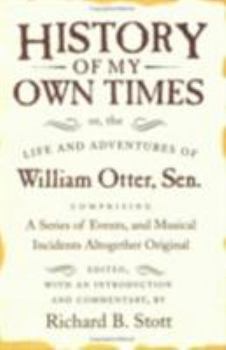
History of My Own Times; Or, the Life and Adventures of William Otter, Sen., Comprising a Series of Events, and Musical Incidents Altogether Original

Select Format
Select Condition 
Book Overview
Big Bill Otter was one member of the early American working class not preoccupied with republican principles or the heritage of the Revolution. Big Bill Otter--apprentice, journeyman, master plasterer--was a thug. Otter's autobiography, first published in 1835, provides a rare and fascinating counterpoint to romantic notions of virtuous, respectable craftsmen in the early republic. His Life and Adventures offer an inside account of the brawling racism common in the early nineteenth century and sharply detail the rowdy male subculture of the times. Born in England and conscripted into the British Navy during the Napoleonic wars, Otter jumped ship and came to New York City in 1801. He apprenticed as a plasterer and joined an urban gang; later he was a master plasterer, tavernkeeper, slavecatcher, "Jackson man," bigot, town bully, notorious practical joker, borderline psychopath, mayoral candidate, and all-round "jolly fellow." History of My Own Times is one of the few first-person accounts of a rural artisan in pre-genteel America. The book depicts the ambiguities of race relations in the early nineteenth century, sheds light on its definition of manhood, and conveys a sense of humor very different from today's. Richard B. Stott's introduction an, d commentary place Otter in the context of his times and explore the significance of his autobiography in understanding the social and cultural history of the early American republic.
Format:Paperback
Language:English
ISBN:0801499615
ISBN13:9780801499616
Release Date:April 1995
Publisher:Cornell University Press
Length:256 Pages
Weight:0.79 lbs.
Dimensions:0.6" x 6.0" x 9.0"
Age Range:18 years and up
Grade Range:Postsecondary and higher
Related Subjects
Americas Biographical Biographies Biographies & History Biography & History Historical HistoryCustomer Reviews
1 rating
Refreshingly candid look at early American life.
Published by Thriftbooks.com User , 27 years ago
"History of My Own Times" explodes the notion we have genteel craftsmen in the early republic working with thrift, sobriety and industry to build the nation. The autobiography of Bill Otter, an Englishmen in early America, this book shows a far darker side of the working class than we may have believed. Otter is a cheat, bully, and bigot, dedicated as much to playing tricks on people as he is to working. HIs story is told in his own words and the jarring difference between the image of the "good guy" he tries to project and the reality of the rough and tumble brawler he really was is a revelation. Richard Stott, the editor, takes Otter's story and deftly ties it into relatively unknown facet of our social history. This is one of the best books on early American life I've read in many years.
Copyright © 2026 Thriftbooks.com
Terms of Use | Privacy Policy | Do Not Sell/Share My Personal Information | Cookie Policy | Cookie Preferences | Accessibility Statement
ThriftBooks ® and the ThriftBooks ® logo are registered trademarks of Thrift Books Global, LLC
ThriftBooks ® and the ThriftBooks ® logo are registered trademarks of Thrift Books Global, LLC
