


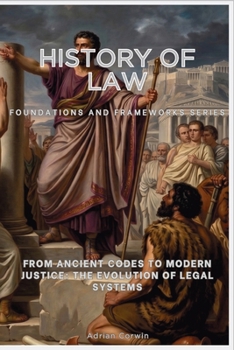
History of Law, Foundations and Frameworks Series: From Ancient Codes to Modern Justice: The Evolution of Legal Systems

The history of law explained in plain language, starting with rules carved into stone four thousand years ago and ending with the courts and constitutions that govern us now. No legal background required.
Ten chapters move in a straight line across those four thousand years, each one building on the last, so the reasoning behind one legal system carries forward into the next. Every chapter ends with a discussion question, and worked example answers sit at the back so you can test your thinking against a full response.
Legal history, chapter by chapter:
- Law before writing existed, when kin groups, elders, ritual, and the threat of revenge kept order for tens of thousands of years
- The first written codes: Ur-Nammu, Hammurabi's black stone pillar with its class-based penalties, Egyptian Ma'at, the Hittite laws, and the civil side of Mosaic law
- Athens and Rome: Draco and Solon, citizen juries, Plato and Aristotle on justice, the Twelve Tables, Justinian's Corpus Juris Civilis, and Roman rules on property, contract, and tort that still shape Europe and Latin America
- Legal thought outside the West, including the Arthashastra, the Laws of Manu, and the fight between Legalism and Confucianism in early China
- Islamic jurisprudence, its four Sunni schools, and the qadi who decided cases
- Canon law, feudal obligation, Magna Carta in 1215, and the common law built out of Henry II's court reforms
- Hobbes, Locke, and Rousseau, the 1689 English Bill of Rights, the U.S. Constitution, the Napoleonic Code, and the natural rights theory running underneath all of them
- The two legal families that divide the modern world, the growth of international law after Westphalia, the 1948 Universal Declaration, war crimes prosecution, and the pressure that AI regulation and cross-border jurisdiction now put on courts everywhere
Written for:
- Students and general readers with no legal training
- Anyone about to start law school who wants context before the casebooks arrive
- Teachers and course designers assembling a unit on legal or world history
- Readers of ancient and medieval history who want the legal side of the story
Four sections follow the final chapter. A conclusion pulls the threads together and asks what four thousand years of argument about fairness actually settled. A timeline walks through the major moments in order. A glossary defines the vocabulary used throughout, so a term like awilum or qiyas never stops you mid-page. An annotated reading list points toward the strongest next books on ancient, Roman, Islamic, and comparative law, with a note on what each one does well.
Knowing where the right to a fair trial came from, or why a contract dispute plays out one way in France and another in the United States, changes how the present looks. This book gives you that background in one clear line of development, at a length you can finish in a weekend.
Customer Reviews
ThriftBooks ® and the ThriftBooks ® logo are registered trademarks of Thrift Books Global, LLC
