


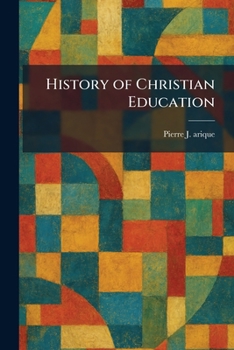
History of Christian Education

"History of Christian Education" provides a systematic survey of the development of educational theory and practice within the Christian world. From the origins of Christianity through the Middle Ages and into the early 20th century, this work outlines the pedagogical shifts and institutional growth that defined Western learning. Pierre J. Marique explores the intersection of theology and instruction, detailing how the Church served as a primary vessel for the preservation of knowledge and the cultivation of culture through various historical periods.
The narrative focuses on the evolution of schools, from early catechetical instruction to the rise of the great medieval universities and the educational changes following the Reformation. By analyzing the philosophies of prominent Christian educators and the structural changes in formal schooling, the book highlights the enduring relationship between religious faith and the pursuit of intellectual excellence. "History of Christian Education" remains a significant contribution to the study of educational history, offering readers a clear perspective on the religious roots of modern scholastic traditions. This work is an invaluable resource for educators, historians, and theologians interested in the deep-seated heritage of Christian intellectual life.
This work has been selected by scholars as being culturally important, and is part of the knowledge base of civilization as we know it. This work was reproduced from the original artifact, and remains as true to the original work as possible. Therefore, you may see the original copyright references, library stamps (as most of these works have been housed in our most important libraries around the world), and other notations in the work.
This work is in the public domain in the United States of America, and possibly other nations. Within the United States, you may freely copy and distribute this work, as no entity (individual or corporate) has a copyright on the body of the work.
As a reproduction of a historical artifact, this work may contain missing or blurred pages, poor pictures, errant marks, etc. Scholars believe, and we concur, that this work is important enough to be preserved, reproduced, and made generally available to the public. We appreciate your support of the preservation process, and thank you for being an important part of keeping this knowledge alive and relevant.
Customer Reviews
ThriftBooks ® and the ThriftBooks ® logo are registered trademarks of Thrift Books Global, LLC
