


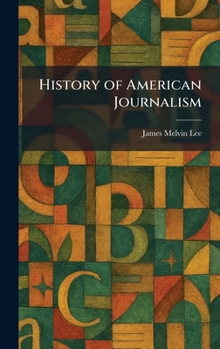
History of American Journalism

"History of American Journalism" by James Melvin Lee offers a comprehensive and authoritative survey of the evolution of the press in the United States. Tracing the development of news dissemination from its earliest colonial beginnings through the early twentieth century, this work serves as an essential chronicle of the people and events that shaped American media.
The narrative explores the rise of the first colonial gazettes, the pivotal role of printers during the American Revolution, and the subsequent expansion of the daily newspaper across the growing nation. Lee meticulously details the technological advancements in printing, the emergence of major news agencies, and the shifting standards of editorial practice. From the partisan broadsides of the early Republic to the professionalization of reporting in the industrial age, the book examines how journalism became an integral component of American democratic life.
By highlighting the careers of influential editors and the socio-political impact of their publications, "History of American Journalism" provides deep insight into the historical roots of mass communications. It remains a vital resource for scholars, students, and anyone interested in the enduring influence of the printed word on public discourse and national identity.
This work has been selected by scholars as being culturally important, and is part of the knowledge base of civilization as we know it. This work was reproduced from the original artifact, and remains as true to the original work as possible. Therefore, you may see the original copyright references, library stamps (as most of these works have been housed in our most important libraries around the world), and other notations in the work.
This work is in the public domain in the United States of America, and possibly other nations. Within the United States, you may freely copy and distribute this work, as no entity (individual or corporate) has a copyright on the body of the work.
As a reproduction of a historical artifact, this work may contain missing or blurred pages, poor pictures, errant marks, etc. Scholars believe, and we concur, that this work is important enough to be preserved, reproduced, and made generally available to the public. We appreciate your support of the preservation process, and thank you for being an important part of keeping this knowledge alive and relevant.
Customer Reviews
ThriftBooks ® and the ThriftBooks ® logo are registered trademarks of Thrift Books Global, LLC
