


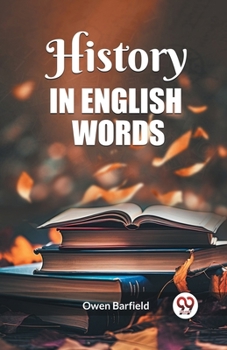
History in English words


Select Format
Select Condition 
Book Overview
"History in English Words" by Owen Barfield is a groundbreaking work of linguistic and literary criticism that delves into the intricate evolution of the English language. Owen Barfield, renowned for his profound insights into language and culture, explores the fascinating journey of English words, tracing their origins and semantic evolution through time. As a pioneering work in philology and historical linguistics, Barfield's book transcends mere lexicography, offering readers a deeper understanding of language development and cultural evolution. Through meticulous analysis, Barfield uncovers the interconnectedness of language and society, revealing how shifts in cultural dynamics shape the meanings and usage of words over centuries. Within the realm of English literature, "History in English Words" serves as a valuable resource for scholars and enthusiasts alike, providing invaluable insights into the linguistic underpinnings of literary works. Barfield's exploration of word origins and semantic evolution offers a nuanced perspective on the richness and complexity of the English language, enriching our appreciation of English literature and enhancing our understanding of linguistic phenomena. With its blend of linguistic inquiry and literary criticism, "History in English Words" stands as a seminal contribution to the study of language and culture, inviting readers to embark on a captivating journey through the annals of linguistic history.
Format:Paperback
Language:English
ISBN:9362768933
ISBN13:9789362768933
Release Date:April 2024
Publisher:Double 9 Books
Length:186 Pages
Weight:0.53 lbs.
Dimensions:0.4" x 5.5" x 8.5"
Customer Reviews
3 ratings
Words as windows to the past.
Published by Thriftbooks.com User , 16 years ago
I read "History in English Words" because I expected it would provide me with some technical knowledge of language which would aid me in my explorations of poetry and other cultural and literary works. I believe it did add some worthwhile sense of the evolution of usage of many English words which are common to literature, such as: romantic, imagination, genius, original, fantasy and scores of others. Meanings of many common words have shifted, and in some cases, are understood in a completely different sense than say, what they meant to Shakespeare. I soon discovered that the larger, and more meaningful purpose of the book is to analyze how the changes in the languages of European civilization reflect the evolution of the mental outlook, or consciousness, of that civilization. As a background, Barfield recaps what was then known(in 1953)about the ancient people known as Aryans, or today as Indo-Europeans, who through migrations later became Greeks, Romans, Slavs, Celts, Iranians,etc. But the real gist of the book's purpose becomes clear with the examination of the way in which Greek and Latin exemplify, through their usage of words, the difference in world-view of the two different cultures. The ever-practical Romans borrowed heavily from the cultural heritage of the more metaphysical, inward-looking Greeks, but managed to put a more utilitarian spin on those borrowings. These two world-views, inward-looking or outward-looking, are like polarities which succeeding European cultures oscillated between while trying to evolve their concept of what a Christian culture should be. The scholastics of the Middle Ages, the Elizabethans, the romantics of the eighteenth century, the scientifically influenced materialists of the nineteenth century, all invented and modified words which reflect their attempts to define the world. For the most part, Barfield presents this progression to us without favoring any particular outlook, but I think his sentiments are expressed both by the title and contents of the last chapter, "Imagination". In a sort of mystical way, he sees this long linguistic labor of European, and particularly English, culture, as being a gradual assimilation by the human consciousness of the objective, souless world of nature. This slow process of internalization has given man the creative leverage to re-animate nature with meaning derived from human perception, rather than being bound by the concept of man at the mercy of the gods. There is the feeling that Barfield had many more thoughts on the matter, but in this book at any rate, he didn't impose them on the reader. My main quibble with the book is that he wrote very long sentences containing many clauses and asides; so much so that sometimes I had to reread a sentence to pick back up on the main thrust of it. In my opinion, it would have been easier to assimilate his message, and much less tiring if he had made more frequent use of the period. But I can still warmly recommend th
A Walk Through The Ancient Human Mind
Published by Thriftbooks.com User , 18 years ago
Barfield's narrative study of changes in words through the history of the English language that attest to the evolution of human consciousness. Very worthwhile, even if Barfield's style and literary landmarks are dated.
Words as Artifact
Published by Thriftbooks.com User , 26 years ago
History in English Words is a fascinating archeological exploration of societies precursor to those of today that speak the English language. Where nothing or little exists in the archaeological ruins, words reveal lifestyle, thought and patterns of migration. In addition, to following the movement of the precursor civilizations across Asia and Europe. The book is lively and thought provoking. The first half gets a little thin as he approaches the modern age, but then he launches into a new premise, that of the conflict of religious and scientific thought in the second half and the book is reinvigorated.
Copyright © 2026 Thriftbooks.com Terms of Use
| Privacy Policy | Do Not
Sell/Share My Personal Information | Cookie Policy | Cookie Preferences | Accessibility Statement
ThriftBooks® and the ThriftBooks® logo are registered trademarks of Thrift Books Global, LLC
ThriftBooks® and the ThriftBooks® logo are registered trademarks of Thrift Books Global, LLC
