


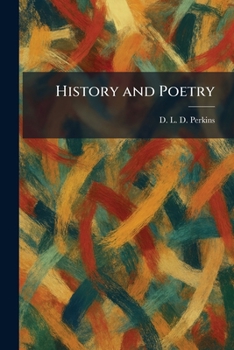
History and Poetry

"History and Poetry" is a compelling exploration of the intersection between historical factualism and the expressive power of verse. Written by D.L.D. Perkins, this work examines how these two distinct disciplines inform and enrich one another, offering a profound look at the way historical events are interpreted through literary art. The book challenges the traditional boundaries between the objective recording of the past and the subjective, emotional resonance found in poetic narratives.
Intended for students of both history and literature, this volume serves as an educational guide that illustrates how poetry can act as a bridge to understanding the human experience in different eras. Perkins provides a nuanced analysis of how rhythmic language and metaphor can capture the spirit of an age in ways that traditional prose might overlook. By synthesizing these fields, "History and Poetry" provides readers with a broader perspective on how memory is preserved and how art serves as a vital component of our historical consciousness. This work remains an important resource for those seeking to understand the deep connections between historical truth and creative imagination.
This work has been selected by scholars as being culturally important, and is part of the knowledge base of civilization as we know it. This work was reproduced from the original artifact, and remains as true to the original work as possible. Therefore, you may see the original copyright references, library stamps (as most of these works have been housed in our most important libraries around the world), and other notations in the work.
This work is in the public domain in the United States of America, and possibly other nations. Within the United States, you may freely copy and distribute this work, as no entity (individual or corporate) has a copyright on the body of the work.
As a reproduction of a historical artifact, this work may contain missing or blurred pages, poor pictures, errant marks, etc. Scholars believe, and we concur, that this work is important enough to be preserved, reproduced, and made generally available to the public. We appreciate your support of the preservation process, and thank you for being an important part of keeping this knowledge alive and relevant.
Customer Reviews
ThriftBooks ® and the ThriftBooks ® logo are registered trademarks of Thrift Books Global, LLC
