


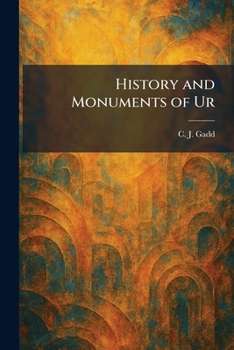
History and Monuments of Ur

Select Format
Select Condition 
Book Overview
"History and Monuments of Ur" provides a comprehensive and scholarly examination of one of the most significant cities of the ancient world. Located in southern Mesopotamia, the city of Ur-often associated with the biblical Ur of the Chaldees-served as a major center of Sumerian civilization. Written by C. J. Gadd, a renowned Assyriologist, this work details the political, social, and religious history of the city, spanning from its earliest prehistoric foundations through its heights under the Third Dynasty to its eventual decline.
The narrative is enriched by a meticulous survey of the city's architectural achievements and monuments, most notably the great Ziggurat. Drawing upon archaeological evidence and cuneiform inscriptions, the author reconstructs the daily lives of its inhabitants, the reigns of its powerful kings, and the evolution of its sacred precincts. Readers will find deep insights into the artistic and cultural contributions of the Sumerians and the subsequent Babylonian and Assyrian influences on the site.
"History and Monuments of Ur" remains a vital resource for those interested in Near Eastern archaeology, ancient history, and the origins of urban civilization. It captures the grandeur of a lost empire and the enduring legacy of its monumental ruins.
This work has been selected by scholars as being culturally important, and is part of the knowledge base of civilization as we know it. This work was reproduced from the original artifact, and remains as true to the original work as possible. Therefore, you may see the original copyright references, library stamps (as most of these works have been housed in our most important libraries around the world), and other notations in the work.
This work is in the public domain in the United States of America, and possibly other nations. Within the United States, you may freely copy and distribute this work, as no entity (individual or corporate) has a copyright on the body of the work.
As a reproduction of a historical artifact, this work may contain missing or blurred pages, poor pictures, errant marks, etc. Scholars believe, and we concur, that this work is important enough to be preserved, reproduced, and made generally available to the public. We appreciate your support of the preservation process, and thank you for being an important part of keeping this knowledge alive and relevant.
Customer Reviews
ThriftBooks ® and the ThriftBooks ® logo are registered trademarks of Thrift Books Global, LLC
