


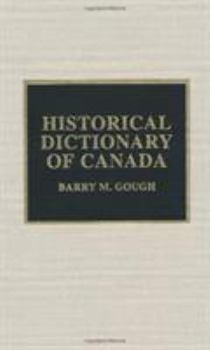
Historical Dictionary of Canada
No Customer Reviews

Select Format
Select Condition 
Book Overview
Though no longer a British colony, Canada has as Head of State Queen Elizabeth II. However, Canadians have not stagnated under an old world order, they have created a government that suits their needs. The largest neighbor to the United States and second largest country in the world after Russia, Canadian borders and off shore islands harbor endless natural resources, ethnic peoples, and climates. Barry Gough offers comprehensive insight into Canada's remarkable and dynamic history through a historical chronology and comprehensive dictionary entries of important places, people, and events.
In the initial historical overview found in the dictionary's introduction, Gough highlights Canada's geography, culture, and history from colonization to NAFTA. Military history is an important aspect of this account, as is the history of the Aboriginal peoples including Indian, Metis, and, Inuit tribes and nations. Gough also includes the defined stages of Canada's self-perception, the four continuities of Canadian history, including its imperial connections, Canada's leadership in the commonwealth, two founding European peoples, federal-provincial relations, and the United States as Canada's neighbor. Gough's Canada is on the brink of a historical event as it comes to grips with its internal struggle between the French speaking people of Quebec and the rest of the country. This dictionary is a handy reference to students of Canadian studies, Canadian history, Canadian government, and colonization studies. Includes a bibliography, maps, and appendixes of Canadian government leaders.Format:Hardcover
Language:English
ISBN:081083541X
ISBN13:9780810835412
Release Date:December 1999
Publisher:Scarecrow Press
Length:320 Pages
Weight:1.15 lbs.
Dimensions:8.7" x 1.1" x 5.7"
Customer Reviews
0 rating
Copyright © 2026 Thriftbooks.com Terms of Use
| Privacy Policy | Do Not
Sell/Share My Personal Information | Cookie Policy | Cookie Preferences | Accessibility Statement
ThriftBooks® and the ThriftBooks® logo are registered trademarks of Thrift Books Global, LLC
ThriftBooks® and the ThriftBooks® logo are registered trademarks of Thrift Books Global, LLC
