


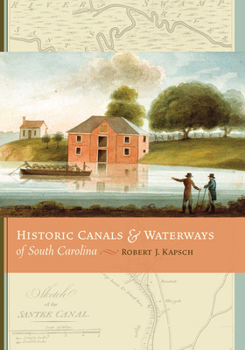
Historic Canals & Waterways of South Carolina

The first history of the canal boom that revolutionized transportation in the Palmetto State
South Carolina's first transportation revolution was the development of a network of canals and waterways. From the 1790s to the 1830s, the Palmetto State was a preeminent leader in infrastructure improvements and developed an extensive system of more than two thousand miles of canals and waterways connecting virtually every part of the state with the coast and the port of Charleston. Robert J. Kapsch expertly recounts the complex history of innovation, determination, and improvement that fueled the canal boom in early-nineteenth-century South Carolina.
At the center of the state's waterway system was the Santee Canal, constructed between 1793 and 1800 to tie the Santee River and its upcountry watershed with the Cooper River and Charleston Harbor in the south. The Santee Canal was America's first summit-level canal--the most complex type of canal to plan, design, and build. Following the War of 1812, South Carolina set about building additional canals and improving navigation on the state's rivers to enable downstream commerce with Charleston via the Santee Canal. During this era South Carolina spent more money per citizen on internal improvements than did any other state. Kapsch chronicles the development and execution of these projects as well as the involvement of major figures in this effort, including John Christian Senf, Robert Mills, Abram Blanding, and Joel R. Poinsett.
As Kapsch notes, the geography of South Carolina dictated the development of its canals and river navigation schemes, but it was cotton, the state's all-important cash crop, that necessitated this mode of transportation. The goal was to transport cotton from plantations across the state to the port of Charleston for shipment. From the first settlement in South Carolina, economic success was in fact dependent on waterways. But in the 1830s the canal boom ended when another transportation innovation, the railroad, superseded waterway travel as primary link to the ports.
In this first comprehensive account of South Carolina's canal history, Kapsch relies on his experience as an engineer and historical researcher, as well as on numerous maps and illustrations, to tell a fascinating and forgotten tale from South Carolina's past.
Customer Reviews
ThriftBooks® and the ThriftBooks® logo are registered trademarks of Thrift Books Global, LLC
