


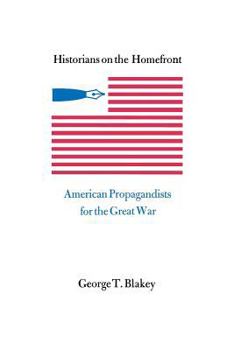
Historians on the Homefront: American Propagandists for the Great War

Select Format
Select Condition 
Book Overview
When Woodrow Wilson called on the American people to mobilize for war in April 1917, it was hardly surprising that historians should respond to their one-time colleague. Mobilization produced three organizations staffed by many of America's leading historians. All three organizations, the author shows, viewed as their task the mobilizing of America's intellectual resources in support of Wilson's war policies. The postwar decade saw an inevitable cooling of wartime passions and a reevaluation of
Format:Paperback
Language:English
ISBN:0813151295
ISBN13:9780813151298
Release Date:July 2014
Publisher:University Press of Kentucky
Length:176 Pages
Weight:0.59 lbs.
Dimensions:0.4" x 6.0" x 9.0"
Grade Range:Postsecondary and higher
Customer Reviews
1 rating
Interesting look at the use of propaganda to support the Great War
Published by Thriftbooks.com User , 17 years ago
This was required reading for a graduate course in the history of American military affairs. George T. Blakey, whose book Historians on the Homefront: American Propagandists for the Great War critically examined the propaganda activities of the Wilson administration by looking into the activities of The Committee on Public Information (CPI) headed by George Creel. Blakey highlights the irony of the unprecedented measures the Wilson administration took in 1917 to promote America's involvement in the war. "Only months earlier he [Wilson] had won re-election to the presidency as the man who `kept us out of war.'" Creel was a well-known "sensational" journalist with plenty of enemies; however, he proved to posses an unprecedented talent for organizing and running the CPI. The CPI's mission was to win over the "hearts and minds" of Americans by using modern propaganda techniques. As Blakey so astutely observed, "While much of the American war effort still bore the imprint of the nineteenth century, the CPI was a true child of the twentieth, using modern methods of psychology, mass production, and advertising to market its product." The main purpose of Blakey's book was to examine in detail one of the CPI's more unusual, and unfortunate partnerships with academia--the National Board for Historical Service (NBHS). In 1917, almost three dozen of America's most eminent historians created the NBHS; an organization that was unfortunately used to draw false historical analogies in an effort to rally American support for the war. Observing the transformation of European political and social structures that a protracted war would bring, president Woodrow Wilson, who had been a historian most of his professional life, wrote to a friend, "`Every reform we have won,' Wilson had said as early as 1914, `will be lost if we go into this war.'" Blakey concluded that, "Good intentions to the contrary, their propaganda work represented a severe break with scholarly historical standards." Recommended reading for anyone interested in American history.
Copyright © 2026 Thriftbooks.com
Terms of Use | Privacy Policy | Do Not Sell/Share My Personal Information | Cookie Policy | Cookie Preferences | Accessibility Statement
ThriftBooks ® and the ThriftBooks ® logo are registered trademarks of Thrift Books Global, LLC
ThriftBooks ® and the ThriftBooks ® logo are registered trademarks of Thrift Books Global, LLC
