


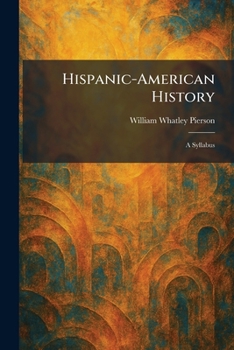
Hispanic-American History: A Syllabus

"Hispanic-American History: A Syllabus" provides a structured and comprehensive outline for the academic study of Latin American history. Designed to guide students and scholars through the multifaceted development of the Western Hemisphere's Spanish and Portuguese-speaking nations, this work spans from the pre-Columbian era to the early 20th century.
The syllabus is organized into logical thematic sections, covering the age of exploration, the establishment of colonial governance, and the revolutionary movements that led to independence. It places significant emphasis on the institutional, religious, and social structures that shaped the region, as well as the evolving diplomatic relationship between Hispanic America and the global community. Each section is supported by detailed references, reflecting the scholarship and historical perspectives of the era.
As a foundational tool for historiography, "Hispanic-American History: A Syllabus" offers invaluable insight into how Latin American history was categorized and taught during a pivotal period of American academic interest. It remains a significant resource for researchers, educators, and historians focusing on the shared heritage and divergent paths of the American republics.
This work has been selected by scholars as being culturally important, and is part of the knowledge base of civilization as we know it. This work was reproduced from the original artifact, and remains as true to the original work as possible. Therefore, you may see the original copyright references, library stamps (as most of these works have been housed in our most important libraries around the world), and other notations in the work.
This work is in the public domain in the United States of America, and possibly other nations. Within the United States, you may freely copy and distribute this work, as no entity (individual or corporate) has a copyright on the body of the work.
As a reproduction of a historical artifact, this work may contain missing or blurred pages, poor pictures, errant marks, etc. Scholars believe, and we concur, that this work is important enough to be preserved, reproduced, and made generally available to the public. We appreciate your support of the preservation process, and thank you for being an important part of keeping this knowledge alive and relevant.
Customer Reviews
ThriftBooks ® and the ThriftBooks ® logo are registered trademarks of Thrift Books Global, LLC
