


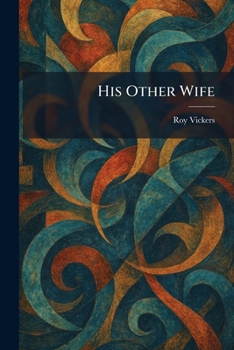
His Other Wife

"His Other Wife" is a gripping work of suspense and social drama by the prolific British author Roy Vickers. Set against the backdrop of early twentieth-century society, the narrative delves into the complexities of marriage, identity, and the shadows of the past. When secrets long buried begin to surface, the characters find themselves entangled in a web of deception that threatens to shatter their carefully constructed lives.
Vickers, a master of intricate plotting and psychological tension, weaves a tale that explores the moral ambiguities and legal intricacies of domestic life. The novel combines elements of the traditional mystery with a poignant exploration of human relationships and the consequences of hidden truths. As the tension mounts, the story moves through the social mores of the 1920s, an era where reputation is paramount and a single mistake can lead to social ruin. "His Other Wife" stands as a compelling example of Vickers' ability to blend psychological insight with tight, suspenseful storytelling, offering readers a fascinating glimpse into the evolution of the British crime thriller.
This work has been selected by scholars as being culturally important, and is part of the knowledge base of civilization as we know it. This work was reproduced from the original artifact, and remains as true to the original work as possible. Therefore, you may see the original copyright references, library stamps (as most of these works have been housed in our most important libraries around the world), and other notations in the work.
This work is in the public domain in the United States of America, and possibly other nations. Within the United States, you may freely copy and distribute this work, as no entity (individual or corporate) has a copyright on the body of the work.
As a reproduction of a historical artifact, this work may contain missing or blurred pages, poor pictures, errant marks, etc. Scholars believe, and we concur, that this work is important enough to be preserved, reproduced, and made generally available to the public. We appreciate your support of the preservation process, and thank you for being an important part of keeping this knowledge alive and relevant.
Customer Reviews
ThriftBooks ® and the ThriftBooks ® logo are registered trademarks of Thrift Books Global, LLC
