


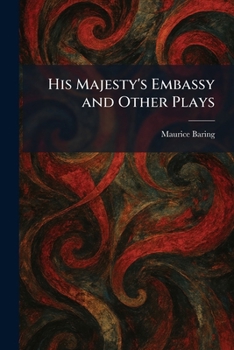
His Majesty's Embassy and Other Plays

"His Majesty's Embassy and Other Plays" is a sophisticated collection of dramatic works by the prolific English author Maurice Baring. This volume showcases Baring's unique ability to blend wit, historical insight, and psychological depth across various theatrical forms. The title play, "His Majesty's Embassy," draws upon Baring's own extensive background in the diplomatic service, offering an authentic and nuanced portrayal of the intricate social and political maneuvering within an international embassy setting.
Accompanying the title piece are works such as "Manfroy, Duke of Athens" and "June-and After," which further demonstrate the author's versatility. "Manfroy, Duke of Athens" explores a more traditional, poetic drama style set against a historical backdrop, while "June-and After" delves into the subtleties of contemporary social life and human relationships. Known for his elegant prose and keen observation, Baring provides a rich tapestry of early 20th-century thought. This collection remains a significant example of English dramatic literature, reflecting the intellectual and social complexities of its time.
This work has been selected by scholars as being culturally important, and is part of the knowledge base of civilization as we know it. This work was reproduced from the original artifact, and remains as true to the original work as possible. Therefore, you may see the original copyright references, library stamps (as most of these works have been housed in our most important libraries around the world), and other notations in the work.
This work is in the public domain in the United States of America, and possibly other nations. Within the United States, you may freely copy and distribute this work, as no entity (individual or corporate) has a copyright on the body of the work.
As a reproduction of a historical artifact, this work may contain missing or blurred pages, poor pictures, errant marks, etc. Scholars believe, and we concur, that this work is important enough to be preserved, reproduced, and made generally available to the public. We appreciate your support of the preservation process, and thank you for being an important part of keeping this knowledge alive and relevant.
Related Subjects
DramaCustomer Reviews
ThriftBooks ® and the ThriftBooks ® logo are registered trademarks of Thrift Books Global, LLC
