


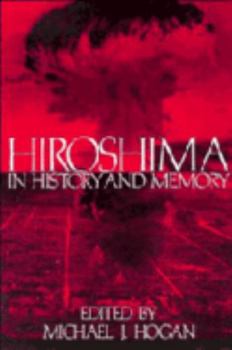
Hiroshima in History and Memory

Select Format
Select Condition 
Book Overview
In this collection of essays, prominent historians survey the Hiroshima story from the American decision to drop the first atomic bomb to the recent controversy over the Enola Gay exhibit in Washington, DC. The first essay surveys the literature on the atomic bombing of Japan, while the second and third essays evaluate the decisions that led to that event. The remaining essays discuss how the Japanese and American people have remembered Hiroshima in the years since the end of World War II. They emphasize the construction of an official memory of Hiroshima, the challenge posed by alternative or counter-memories, and the tension between history and memory in the Hiroshima story. The collection thus unites scholarship by diplomatic historians with the interest in memory that has emerged as part of cultural history.
Format:Paperback
Language:English
ISBN:0521566827
ISBN13:9780521566827
Release Date:June 1996
Publisher:Cambridge University Press
Length:274 Pages
Weight:0.89 lbs.
Dimensions:0.6" x 6.0" x 9.0"
Customer Reviews
3 ratings
Collective Memory that Should Never be Forgotten
Published by Thriftbooks.com User , 20 years ago
The bombing of Hiroshima was one of many horrific events that occurred in World War II and in human history. World War II was a pivotal time, and only in the present are we able to look back and reflect on the event with a critical eye. Michael J. Hogan's HIROSHIMA IN HISTORY AND MEMORY provides a collection of essays by cultural and diplomatic historians who analyzed the bombing of Hiroshima based on unclassified documents and past commentary that emphasized the how and why the bomb was dropped. Although this historiographical collection is considered revisionist scholarship, it is by all means essential in order to understand the complicated decision that President Truman had to make in dropping the bomb, and the effects it has had decades after. Several essays reflect on how the bombing has affected commemoration of the event. Without a clear understanding of Hiroshima from both Americans and Japanese, one cannot equally or fully commemorate or represent the bombing of Hiroshima. The essays in HIROSHIMA AND HISTORY AND MEMORY attempts to present the facts within each essay, and each historian, such as J. Samuel Walker, John W. Dower, Barton J. Bernstein, and a host of others emphasize that the decision to drop the bomb and end the war did not only involve justifying saving military casualties, but the fear of an imminent power on the rise -- the Soviet Union (despite their position as an allie at the time, their possible invasion would have helped the Japanese surrender). HIROSHIMA IN HISTORY AND MEMORY examines basic history as it pertains to the bombing of Hiroshima. The essays are readable and understandable. The events that occurred in August 1945 in Hiroshima and Nagasaki are two major historical events that continue to be a discussion of debate.
Hiroshima books
Published by Thriftbooks.com User , 21 years ago
as far as hiroshima books go. this was the best one i found. i was writting a piece of history coursework on this travesty and this book not only gave me historians views but in the essays they mentioned other historians and their views!! it looked at this event from many different angles and managed to be interesting, factual and collectively unbiased throughout. very thought provoking.
Public Memory V Private Memory
Published by Thriftbooks.com User , 25 years ago
An essential feature of any historical work is the selection ofsources one wishes to present as an argument. The role of memory and access to history, that is public access to 'other' histories, is an area of much contention in the contemporary world. What I most enjoyed about this book is the authors have not shied away from commenting on earlier critiques of the proposed Smithsonian display, involving the restored fuselage of the Enola Gay. What was shameful about the ensuing debacle, I believe, was the attempt to discredit the further development of an alternate memory given 50 years had passed since the atomisation of Hiroshima. After all, was it not possible to show an American and Japanese view of the closing months of the Pacific War, regardless of who the victor was? It is critical to understand that Australians, let alone Japanese, cut a different slant on the way we interpret history, particularly that of Pacific War history. I believe we are richer for the experience.But, of course, an alternate memory has developed, yet it is often dismissed by the euphemistic expression, 'historical revisionism'. This appears to be some sort of code for 'this sort of history is not acceptable to the conservative elements in contemporary American society, certainly much less to those who actually witnessed combat in the Pacific'. By virtue of fact, it has no legitimate place among orthodox histories. All history is subject to revision, for the simple reason new facts become available and each generation chooses to impose it's own standards. This is certainly the case with Hiroshima. But this shouldn't be construed as 'wrong' or a 'threat', rather it adds to the debate and formation of ideas which underpin the importance of Hiroshima and historiography. Context retains an essential place.However, for those of you interested in the importance of historicity, of debate, and value the idea of an education as opposed to acccess to information, I cannot recommend this book enough. It has it all. Needless to say Hiroshima touches a raw nerve both in Japan and America. It also has much currency in Australia. So I do not in any way set out to discredit the efforts of those men and women who gave their services to the state during WW2. I do, however, recommend that prospective readers keep an open mind and try avoid getting caught up in the limited rhetoric of the conservative right and the emotional left.
Copyright © 2026 Thriftbooks.com Terms of Use
| Privacy Policy | Do Not
Sell/Share My Personal Information | Cookie Policy | Cookie Preferences | Accessibility Statement
ThriftBooks® and the ThriftBooks® logo are registered trademarks of Thrift Books Global, LLC
ThriftBooks® and the ThriftBooks® logo are registered trademarks of Thrift Books Global, LLC
