


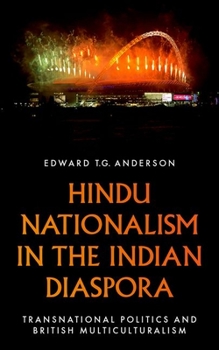
Hindu Nationalism in the Indian Diaspora: Transnational Politics and British Multiculturalism
No Customer Reviews

Hindu nationalism is transforming India, as an increasingly dominant ideology and political force. But it is also a global phenomenon, with sections of India's vast diaspora drawn to, or actively supporting, right-wing Hindu nationalism. Indians overseas can be seen as an important, even inextricable, aspect of the movement. This is not a new dynamic--diasporic Hindutva ('Hindu-ness') has grown over many decades. This book explores how and why the movement became popular among India's diaspora from the second half of the twentieth century. It shows that Hindutva ideology, and its plethora of organisations, have a distinctive resonance and way of operating overseas; the movement and its ideas perform significant, particular functions for diaspora communities. With a focus on Britain, Edward T.G. Anderson argues that transnational Hindutva cannot simply be viewed as an export: this phenomenon has evolved and been shaped into an important aspect of diasporic identity, a way for people to connect with their homeland. He also sheds light on the impact of conservative Indian politics on British multiculturalism, migrant politics and relations between various minoritised communities. To fully understand the Hindutva movement in India and identity politics in Britain, we must look at where the two come together.
Format:Paperback
Language:English
ISBN:0197746209
ISBN13:9780197746202
Release Date:February 2024
Publisher:Oxford University Press
Length:424 Pages
Weight:1.25 lbs.
Dimensions:2.5" x 5.7" x 8.1"
Customer Reviews
0 rating
Copyright © 2026 Thriftbooks.com Terms of Use
| Privacy Policy | Do Not
Sell/Share My Personal Information | Cookie Policy | Cookie Preferences | Accessibility Statement
ThriftBooks® and the ThriftBooks® logo are registered trademarks of Thrift Books Global, LLC
ThriftBooks® and the ThriftBooks® logo are registered trademarks of Thrift Books Global, LLC
