


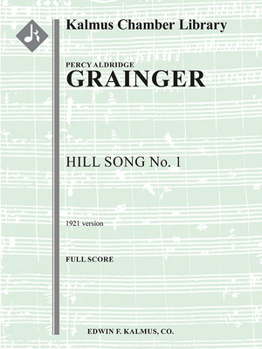
Hill Song No. 1 (1921 Version): Conductor's Score
No Customer Reviews

Hill Song No. 1 is one of the most audacious and forward-looking of all the works by Percy Grainger. Begun in March 1901 while he was still a student at the H ch Conservatoire in Frankfurt, it is one of Grainger's earliest surviving compositions, though Grainger recalled it was a distillation of a number of techniques he tried out experimentally in the late 1890s; wide-tone scales," "irregular rhythms," "democratic polyphony," and "semi-discordant triads" among them. A passage toward the end that bears a misty resemblance to impressionist harmony was inspired, as Grainger admits, by seeing part of the score of Debussy's Pelleas et M lisande in 1902. The first version of Hill Song No. 1 was completed in London in September 1902. The most radical thing about Hill Song No. 1 was its scoring, and indeed, this is what kept it out of the ears of the public for decades. It is scored for 24 winds -- two piccolos, six oboes, six English horns, six bassoons, and contra-bassoon. Due to his relative inexperience as a composer and German training -- after all, he was only 19 years old when he wrote the work -- Grainger spelled out compound rhythms in archaic ways, such as identifying a bar of 5/8 as "two and a half over four." Such rhythmic divisions are scattered throughout all of the 24 parts, with some differing divisions laid on top of one another; the best wind players in the world in 1902 could not read or play the Hill Song No. 1, which is what Grainger realized once he tried to mount a performance of the work. In 1907, he created the short, pithy Hill Song No. 2, which places some of the elements of the earlier piece in a more conventional context and is less than a third as long as the original. In 1921, he completely rebarred and rescored the Hill Song No. 1 for an ensemble of piccolo, flute, six double reeds, two saxophones, three brass, harmonium, percussion, piano, and six string parts. The added instruments were designed to address Grainger's concern about wheeziness of the high number of double reeds in the original version; he also created a version for two pianos at the same time. -Uncle Dave Lewis, AllMusic.com (excerpt) Instrumentation: 1+Picc.1+EH.0.1+CBsn: Sopranino sarrusophone in Eb(alt Ob2).Tenor sarrusophone in Bb(alt heckelphone, Tsax or Bcl): Ssax.Asax: 1.1.0.0.Euph: Perc(1).Harmonium.Pno: Str(1.1.2.2.1)."
Format:Paperback
Language:English
ISBN:1638874905
ISBN13:9781638874904
Release Date:November 2022
Publisher:Alfred Music
Length:999 Pages
Customer Reviews
0 rating
Copyright © 2026 Thriftbooks.com Terms of Use
| Privacy Policy | Do Not
Sell/Share My Personal Information | Cookie Policy | Cookie Preferences | Accessibility Statement
ThriftBooks® and the ThriftBooks® logo are registered trademarks of Thrift Books Global, LLC
ThriftBooks® and the ThriftBooks® logo are registered trademarks of Thrift Books Global, LLC
