


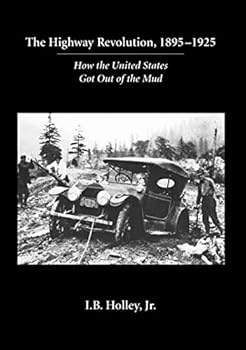
The Highway Revolution, 1895-1925: How the United States Got Out of the Mud
No Customer Reviews

This book is about the creation of a major American business, the highway construction industry. In the 1890s such an industry could scarcely be said to exist; within a generation, by the mid-1920s, highway building and all its ancillary activities had become one of the nation's greatest industries. This multi-faceted volume tells how the appallingly bad interurban highways of 19th-century USA came to be paved when the problem of financing was finally addressed after an extended campaign by diverse interest groups. Successive chapters deal with the early phases of waterbound crushed stone macadam, the hand tool and horse-powered machinery developed to build and maintain such highways, gradually giving place to steam powered machinery which lowered the cost and speeded the pace of construction. Other chapters recount the many difficult problems of contractors estimating costs to submit winning bids and learning to achieve quality production with such novel materials as asphalt and concrete. The volume fills a surprising void in the history of highway paving as very little has been written on the problems confronting highway contractors and the state engineers who supervised them. "Highly recommended." -- H.R. Grant, Clemson University, CHOICE Magazine "Drawing on extensive historical research in engineering journals, industry publications, and road-building manuals, Holley explores the multiple factors that comprised this highway revolution. Holley's account of the highway revolution is at its strongest when he is relating tales of technical innovation, pushed forward by highway workers seeking some labor-saving device." -- Michael R. Ferin, Technology and Culture
Format:Hardcover
Language:English
ISBN:1594603537
ISBN13:9781594603532
Release Date:February 2008
Publisher:Carolina Academic Press
Length:214 Pages
Weight:1.10 lbs.
Dimensions:9.3" x 0.8" x 6.3"
Customer Reviews
0 rating
Copyright © 2026 Thriftbooks.com Terms of Use
| Privacy Policy | Do Not
Sell/Share My Personal Information | Cookie Policy | Cookie Preferences | Accessibility Statement
ThriftBooks® and the ThriftBooks® logo are registered trademarks of Thrift Books Global, LLC
ThriftBooks® and the ThriftBooks® logo are registered trademarks of Thrift Books Global, LLC
