


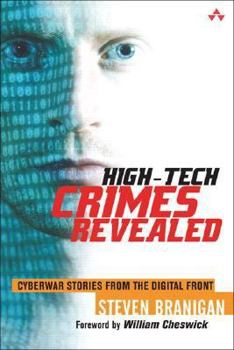
High-Tech Crimes Revealed: Cyberwar Stories from the Digital Front

Helps to educate people on the issues with high-tech crimes. This book demystifies the risks and realities of high-tech crimes. It looks at how digital crimes are discovered, what techniques the... This description may be from another edition of this product.
Format:Paperback
Language:English
ISBN:0321218736
ISBN13:9780321218735
Release Date:January 2004
Publisher:Addison-Wesley Professional
Length:448 Pages
Weight:1.55 lbs.
Dimensions:1.0" x 5.9" x 9.1"
Customer Reviews
5 ratings
Documenting a new frontier of the war against terrorism
Published by Thriftbooks.com User , 21 years ago
Author Steven Branigan is involved with many real incidents of high-tech crimes, and in High-Tech Crimes Revealed: Cyberwar Stories From The Digital Front provides details on how to find out what actually takes place in such crimes. From the specific abuses of computers and technology to the legal and social concerns often overlooked in cyber-crimes, Branigan's collection of real-world cyberwar stories is enlightening - and frightening, documenting a new frontier of the war against terrorism.
Great book for management
Published by Thriftbooks.com User , 21 years ago
High-Tech Crimes Revealed is a great book for management. The stories are real, written in non-technical language. Makes for very interesting reading.
Teaching security through stories
Published by Thriftbooks.com User , 21 years ago
I really enjoyed this book, first for it's technical content, as you would expect. Then second as a set of interesting stories about security. And it's these stories that bring security issues to life. This is not a reference book. The technical content is related directly to the stories and case studies. But the technical content is still very compelling, well written and in-depth. If you are looking for a book on how to secure Linux or NT, this is not your book. I think this book is written for people with a passion about security and who are serious about a career in information security. Those types of people will love this book.
The complete range of computer crimes
Published by Thriftbooks.com User , 21 years ago
Few things really change in human society. As computers become more ubiquitous, the criminal elements of society find ways to use them for profit. There is also the teen vandal/joyrider element as well. Young people, traditionally males, have always embarked on "adventures" for thrills and to prove that they can do it. The difference when they use computers is that the consequences are orders of magnitude greater. Formerly, when a young person threw a rock through a window to be obnoxious, the damage was restricted to the window. Now, if a young hacker writes a particularly virulent computer virus, it can lead to worldwide costs in the billions. The legal systems of the world are struggling to keep up with the technological advancement. The definitions of some fundamental principles of law have had to be substantially modified so that certain actions can be considered a crime. Consider the definition of trespassing. Before computers were ubiquitous, it was the act of physically moving to locations declared off-limits. Now, it also includes the virtual entry into a computer system. In this book, case histories covering the range of computer "incidents" are covered. Some of them are the computer equivalent of a joyride, where a hacker penetrates a system just to prove that they can do it. Few alterations to the system were done, in many cases they left nothing more than the digital equivalent of a pile of mud in the hall to announce their presence. Other case histories deal with some of the more serious crimes, where money and credit card numbers, the digital equivalent of money, were stolen. I personally would have liked to read more detailed descriptions of these crimes. Of course, this is not necessarily the author's fault, as the victims of these crimes are very reluctant to release information on how the crime was perpetrated. The most interesting data in the book concerns the tactics that one must use in capturing the evidence needed to convict a hacker in a court of law. Since digital data is so easily altered, (forged), the rules of evidence gathering are very precise. The slightest misstep can render the evidence tainted at best and worthless at worst. The author has a great deal of experience in ferreting out computer criminals, and this book is in many ways a recapitulation of criminal behavior. To catch a criminal, you must think like a criminal. The strategies he used in virtual stakeouts are sound advice for anyone who suspects that their computer systems are under attack. This of course is nearly everyone, because if people can log onto your computer, you should consider it at risk. Computer crime is no different from traditional forms of crime such as robbery, assault, and criminal trespass. If it is allowed to go unchecked, the very fabric of society is at risk. In one way it is different, in that the consequences of what many might consider the act of simple irresponsibility can lead to significant monetary damages and even
Good material with a small caveat...
Published by Thriftbooks.com User , 21 years ago
I recently finished the book High-Tech Crimes Revealed - Cyberwar Stories From The Digital Front by Steve Branigan (Addison-Wesley). It's a pretty good book, but with a few shortcomings... Chapter list: An Attack on the Telephone Network; An Attack on an ISP; If He Had Just Paid the Rent; Inside a Hacker Sting Operation...; Identity Theft; Let's Ask the Hackers; Why Do Hackers Hack?; Setting the Stage; High-Tech Crime; What Not to Do; How to Run a High-Tech Case; What Have We Learned; Appendix; Bibliography; Index There are two types of writing in this book. Up through Inside A Hacker Sting Operation, the focus is on real-life cases that the author was part of. You learn details about how cyber-crime is conducted, uncovered, and prosecuted. The benefit here is that you see the warts and failings of the process instead of the glorified versions as told by security experts. After that chapter, there is less emphasis on stories and more focus on subjects, such as why these things occur and how to conduct an investigation. There are still references to real-life events, but that's less of an emphasis. Branigan's writing is humorous and lightly satirical, and makes for an enjoyable read. The shortcoming was something I couldn't quite put my finger on until I read the preface. Steve started this book in 1999 and thought he'd be done in early 2002. September 11th threw him off, and he didn't get started again until nearly a year later. So in effect, you have a book on cyber-crime published in 2004 that was largely written between 1999 and 2001. While there are references to events in the recent past, many of the significant stories and examples are vintage 2002 or earlier. In my opinion, it's the only significant flaw in what is otherwise an interesting read.
Copyright © 2026 Thriftbooks.com Terms of Use
| Privacy Policy | Do Not
Sell/Share My Personal Information | Cookie Policy | Cookie Preferences | Accessibility Statement
ThriftBooks® and the ThriftBooks® logo are registered trademarks of Thrift Books Global, LLC
ThriftBooks® and the ThriftBooks® logo are registered trademarks of Thrift Books Global, LLC
