


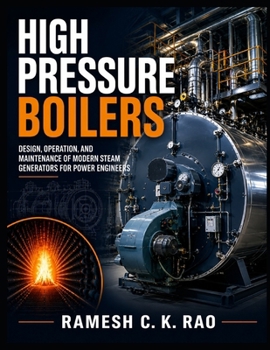
High Pressure Boilers: Design, Operation, and Maintenance of Modern Steam Generators for Power Engineers
No Customer Reviews

The steam still has to be made. Behind every megawatt on the grid and every process that runs on heat, a high-pressure boiler is turning fuel into steam at conditions that grow more demanding each year - higher pressure, hotter steam, tighter emissions limits, and the flexibility to follow a grid that no longer runs flat out.
Many engineers reach that boiler well-versed in the thermodynamics of the steam cycle and the names of the parts, yet unable to say why the machine is built the way it is. Why does circulation weaken as pressure climbs toward the point where water and steam become indistinguishable? How is steam temperature held steady as load swings through the day? What really changes when a unit crosses from subcritical to supercritical operation, or must fire cleaner fuels and confront carbon? Older references often stop where modern practice begins.
This comprehensive guide is written to close that gap. It builds from first principles to working application - deriving each equation from stated assumptions, defining every symbol in plain language, and carrying units through every worked example. Notation is fixed early and reused throughout, so the reasoning behind the hardware stays visible from the first chapter to the last.
Inside, you will be able to: Analyse the steam cycle and see how reheat, regeneration, and rising pressure and temperature set efficiency and heat rateUnderstand circulation in tube boilers and why high pressure forces the move to once-through and supercritical designsFollow combustion from fuel analysis and excess air to flame temperature, losses, and boiler efficiencyCompare fluidized-bed and pulverized-fuel firing, with their temperature windows, sulphur capture, and fuel flexibilityHold steam temperature through superheaters, reheaters, attemperation, and the metal-temperature limits that govern materialsWork with economizers, air preheaters, feedwater heating, and the heat recovery steam generator at the heart of the combined cycleManage drum-level and combustion control, draught, safety valves, blowdown, water chemistry, corrosion, and emissionsWritten to current practice, the book reflects the move through supercritical and ultra-supercritical steam toward advanced ultra-supercritical operation, the growth of fluidized-bed combustion to utility scale, and the decarbonization pressures now shaping design. Each chapter opens with objectives and closes with practice problems and worked solutions, making it as useful for structured study as for later reference.
It is written for the upper-level student moving from theory into steam generation, and for the early-career power, plant, or mechanical engineer who must specify, operate, or troubleshoot a boiler and wants the reasoning, not just the labels.
Add this practical, up-to-date reference to your library and begin building a clearer, code-aware understanding of how modern steam generators are designed, operated, and maintained.
Many engineers reach that boiler well-versed in the thermodynamics of the steam cycle and the names of the parts, yet unable to say why the machine is built the way it is. Why does circulation weaken as pressure climbs toward the point where water and steam become indistinguishable? How is steam temperature held steady as load swings through the day? What really changes when a unit crosses from subcritical to supercritical operation, or must fire cleaner fuels and confront carbon? Older references often stop where modern practice begins.
This comprehensive guide is written to close that gap. It builds from first principles to working application - deriving each equation from stated assumptions, defining every symbol in plain language, and carrying units through every worked example. Notation is fixed early and reused throughout, so the reasoning behind the hardware stays visible from the first chapter to the last.
Inside, you will be able to: Analyse the steam cycle and see how reheat, regeneration, and rising pressure and temperature set efficiency and heat rateUnderstand circulation in tube boilers and why high pressure forces the move to once-through and supercritical designsFollow combustion from fuel analysis and excess air to flame temperature, losses, and boiler efficiencyCompare fluidized-bed and pulverized-fuel firing, with their temperature windows, sulphur capture, and fuel flexibilityHold steam temperature through superheaters, reheaters, attemperation, and the metal-temperature limits that govern materialsWork with economizers, air preheaters, feedwater heating, and the heat recovery steam generator at the heart of the combined cycleManage drum-level and combustion control, draught, safety valves, blowdown, water chemistry, corrosion, and emissionsWritten to current practice, the book reflects the move through supercritical and ultra-supercritical steam toward advanced ultra-supercritical operation, the growth of fluidized-bed combustion to utility scale, and the decarbonization pressures now shaping design. Each chapter opens with objectives and closes with practice problems and worked solutions, making it as useful for structured study as for later reference.
It is written for the upper-level student moving from theory into steam generation, and for the early-career power, plant, or mechanical engineer who must specify, operate, or troubleshoot a boiler and wants the reasoning, not just the labels.
Add this practical, up-to-date reference to your library and begin building a clearer, code-aware understanding of how modern steam generators are designed, operated, and maintained.
Format:Paperback
Language:English
ISBN:B0HBC8M6BT
ISBN13:9798188805111
Release Date:July 2026
Publisher:Independently Published
Length:562 Pages
Weight:2.83 lbs.
Dimensions:1.1" x 8.5" x 11.0"
Customer Reviews
0 rating
Copyright © 2026 Thriftbooks.com
Terms of Use | Privacy Policy | Do Not Sell/Share My Personal Information | Cookie Policy | Cookie Preferences | Accessibility Statement
ThriftBooks ® and the ThriftBooks ® logo are registered trademarks of Thrift Books Global, LLC
ThriftBooks ® and the ThriftBooks ® logo are registered trademarks of Thrift Books Global, LLC
