


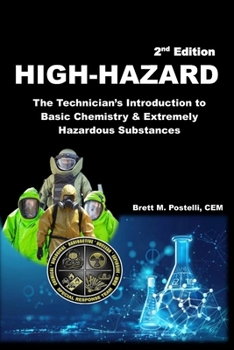
High-Hazard: The Technician's Introduction to Basic Chemistry & Extremely Hazardous Substances - 2nd Edition
No Customer Reviews

This handbook provides entry-level High-Hazard Response Technicians (HHRT) with fundamental chemistry concepts, explanations for standard terms, chemical/physical properties, and reactive behaviors encountered when using safety data sheets, chemical dictionaries, NIOSH Pocket Guide, and other chemical reference materials. The most challenging and potentially lethal forms of chemicals, compounds, mixtures, and substances are identified as High-Hazard or Extremely Hazardous Substances (EHS). They will be used interchangeably throughout this handbook. Highly hazardous substances contain energetic, reactive, and chemical compositions, resulting in a higher risk of causing death, disabling personal injury, or serious illness. EHS substances are more dangerous than ordinary hazardous substances, yet all levels of substances, extremely hazardous or not, share the same basic chemistry principles and concepts. In many cases, hazardous materials and high-hazard technicians are not chemical engineers or subject matter experts on the materials they respond to. However, having some basic knowledge and understanding of chemistry terms, atomic structures, chemical properties, compatibility, and reactive behaviors will help personnel when choosing the proper personal protective equipment (PPE), performing field sampling and chemical identification procedures, considering manual or remote handling precautions, implementing collection procedures, chemical segregation, neutralization, transportation, and disposal methods. Basic chemistry knowledge gives the technician a more in-depth perspective when referencing safety data sheets (SDS) and other references such as chemical dictionaries. There are numerous scientific fields explicitly focused on the field of chemical process management and hazardous substances. This handbook covers two basic fundamental scientific chemistry practices regarding hazardous substances: organic and inorganic. Additional topics of discussion will address specific substance categories, classifications, reactive, and energetic properties. **** This handbook is intended to be used as an entry-level reference guide when specific chemistry terms, properties, and behaviors are encountered in the field. This handbook should be used as a training add-on to the 40-hr. HAZWOPER course expanding on energetic, reactive, and extremely hazardous chemicals. This information will help the technician better understand the NIOSH Pocket Guide's chemical/physical properties, and reactivity sections. This handbook is NOT intended to be a comprehensive textbook to teach or instruct the reader in the complex fields of chemistry or related sciences. ****
Format:Paperback
Language:English
ISBN:B0DZX4NFNB
ISBN13:9798312752137
Release Date:March 2025
Publisher:Independently Published
Length:700 Pages
Weight:2.03 lbs.
Dimensions:1.4" x 6.0" x 9.0"
Customer Reviews
0 rating
Copyright © 2026 Thriftbooks.com
Terms of Use | Privacy Policy | Do Not Sell/Share My Personal Information | Cookie Policy | Cookie Preferences | Accessibility Statement
ThriftBooks ® and the ThriftBooks ® logo are registered trademarks of Thrift Books Global, LLC
ThriftBooks ® and the ThriftBooks ® logo are registered trademarks of Thrift Books Global, LLC
