


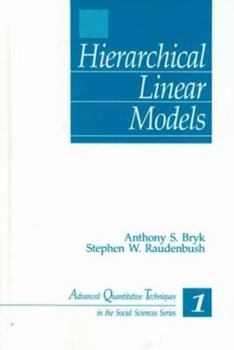
Hierarchical Linear Models: Applications and Data Analysis Methods (Advanced Quantitative Techniques in the Social Sciences)


Select Format
Select Condition 
Book Overview
"This monograph offers a careful introduction to models designed to deal with interactions between individual and contextual effects . . . . This book is an important contribution to the analysis of hierarchical data. It presents the material in sufficient depth without ignoring the demands of nonspecialists."
--American Journal of Sociology
"This is a first-class book dealing with one of the most important areas of current research in applied statistics . . . . The methods described are widely applicable . . . the standard of exposition is extremely high."
--Short Book Reviews, Publication of the International Statistical Institute
"No other introductory text on hierarchical or multilevel models attempts to take the reader through a carefully structured set of examples, and so this book is certainly welcome . . . . I would recommend it to those who would like an introduction to the topic and a glimpse of some of the potential power of multilevel models.
--Journal of the American Statistical Association
Much social and behavioral research involves hierarchical data structures. The effects of school characteristics on students; how differences among countries in governmental policies influence demographic relations within them; and how individuals exposed to different environmental conditions develop over time are but a few examples. However, past analysis of such data has been fraught with problems. Recent developments in the statistical theory of hierarchical linear models now afford an integrated set of methods for such applications.
Now a best-seller, Hierarchical Linear Models launched the Sage series, Advanced Quantitative Techniques in the Social Sciences. This introductory text explicates the theory and use of hierarchical linear models (HLM) through rich, illustrative examples and lucid explanations. The presentation remains reasonably nontechnical by focusing on three general research purposes--improved estimation of effects within an individual unit, estimating and testing hypotheses about cross-level effects, and partitioning of variance and covariance components among levels. This innovative volume describes use of both two-and three-level models in organizational research and studies of individual development and meta-analysis applications and concludes with a formal derivation of the statistical methods used in the book.
Customer Reviews
THE Book - dense but important
The classic text on Hierarchical Linear Modeling
pre-req: mid-level stats experience
Useful, but need solid background in stats
ThriftBooks® and the ThriftBooks® logo are registered trademarks of Thrift Books Global, LLC
